Featured

P&C Press Release

Purpose Statement: This blog post will talk about what to focus on and why in a potential press release for my Writing 310 class.

Press releases are one of the best ways to get publicity for a business. They can be read quickly, shared easily, and give concise information. So, if you’re a small business that wants some attention from the press, then one of the best ways to do that is to get a press release.

In Writing 310 today, we talked about press releases and how you would write one. We were challenged to come up with some ideas for a press release, for the businesses that we are working with this semester. The business I’ve been working with is Pulp & Circumstance, and so my group was coming up with ideas.

The problem with this is that Pulp & Circumstance is not a very active business. They mostly showcase their products, which are stationery and stickers and souvenirs, and that’s it. So, our group came up with two potentially good ideas: once focusing on their newer seasonal products, and one focusing on their secondary business, the Airbnb.

P&C regularly sells products based on the holidays and seasons of the year. For example, they have recently been selling Easter-themed goods, in keeping with the Easter season. So, since this is one of the things that they regularly change up about their business, it would be something that they could write a press release on. It would be a good way to not only get some publicity, but also showcase whatever new summery products they are releasing.

A press release focusing on their Airbnb might also be helpful. Firstly, they need to give “The Rooms Upstairs” more publicity in general, since many people I have talked to who know about P&C didn’t know that they rent out rooms. A press release on this would spread awareness of its existence and bring in more customers. Also, late spring would be the perfect time to spread more information about their rooms for rent, since summer is a very common time for travel, and anyone traveling to or through Newberg would be looking for a good place to stay. Presenting “The Rooms Upstairs” as a good overnight option would be very good for business.

Featured

Using SEO Content Writing

Purpose Statement: This blog post is meant to describe for my Writing 310 class what SEO content writing is, and how I can best utilize it in my business profile writing.

Since I unfortunately missed the lecture today, instead of writing about our guest speaker, I’m going to write about the best ways that I can use SEO when I’m writing business profiles. SEO stands for Search Engine Optimization: what you do in writing when you’re looking to draw people in from search engines such as Google.

In order to do SEO content writing, you need to keep a couple things in mind. The first one is use of keywords. What words sum up this business? If a potential customer is searching Google, what would they put in that would help them find this business? Is it a “souvenir store,” a “trendy restaurant,” a “repair shop”? For example, Pulp & Circumstance, the business I’m writing for, might want to include keywords such as “souvenir” and “gift.” Things like “art” and “boutique” may also be helpful.

One of the other best things you want to do is organize your content logically. If someone goes to scroll on your page and find information, you want to have the most necessary stuff available easily. For example, where is your business? What do you offer? What are the prices? Further on you could offer extra details, such as what your business has that others might not, or promotions and deals you might be offering. You don’t want to open with a long-winded story or make the information hard to find, or potential customers would get frustrated and take their services to somewhere more accessible.

Keeping these things in mind will make it a lot easier for me to consider what to write in my business profiles. The keywords will especially be helpful, since I’ll have a list of things that I want to include. I can just fill them in the sentences: “souvenir,” “tourism,” “shop,” “boutique.” I’ll also try to be audience aware when I organize the information, so that it flows in a way that is easy to read.

Featured

NDC Business Profiles

Purpose Statement: This blog post is to share my thoughts about the business profiles on the Newberg Downtown Committee’s website with the rest of my Writing 310 class.

The Newberg Downtown Committee, according to their own website, is a “volunteer-based organization” that is “making downtown Newberg into a destination that enriches the lives of those who visit and live here.” As part of their efforts, they have a website that lists many of the businesses in the area, such as different dining, shopping and lodging options. For this blog post I’ll be looking at the business profiles that they put up, and analyzing what is good or bad about them.

The good things that the profiles have are honestly the most important parts. Each listing has the business’s name, address, and hours. Most of them display the business’s logo. If you click further into the business, you’ll be given relevant contact information (such as phone numbers and emails), as well as a link to their website if they have one. A few profiles redirect specifically to the website, such as the one for the Chehalem Aquatic Center. A handful also have summaries of what the business offers, most of which are under the “shopping” category, such as the plant shop Uflora or the souvenir shop Pulp & Circumstance.

However, aside from basic information, these profiles don’t have much going for them. They rarely tell you why you would want to visit these places, but merely offers the names and addresses and links to more information. While the info is often available through further research, it would be a lot more convenient to have a given reason up front. The profiles rarely talk up the businesses at all, such as saying that they were “voted the best restaurant in 2013” or something along those lines. And the fact that only some of the profiles have summaries is jarring as well. It doesn’t flow very well to see a detailed paragraph about one place and a dearth of explanation about another. So what these profiles really need is better summaries, likely better formatting to make them more pleasing to the eye as well. As we talked about in class, a profile should make you want to visit the business.

Featured

Bill Gates White Paper

Purpose Statement: This blog post for my Writing 310 class analyzes the “Postsecondary Success” White Paper, and addresses the things it does right as well as the problems with it.

In class today we read this white paper, which is about some of the major issues that higher education in the United States has, and some of the possible solutions that could be offered. I think this white paper did a good job of explaining some of the problems, such as unaffordability and inaccessibility. Being a student in college currently, I definitely understand what the issues are, since I’m in the process of dealing with them. The paper wasn’t the most well organized, since it only went very in-depth about the issues right at the end of the paper, when it would have served best (in my opinion) to go in-depth about the solutions instead. What I can say is that they did do well with covering the many issues in higher education.

However, while the paper did a good job of identifying the problems, it did a less than stellar job of identifying solutions. There was definitely an attempt to do so, but while the paper said that the Bill Gates foundation was “committed to ensuring that all students have the opportunity to receive a high-quality education,” and said that they would work to fix the problems, they were not very specific as to how. There was a link at the top of the page to some more in depth information about their programs, but the paper itself only really identified the issues, which made it somewhat one-sided. However, the information was at least somewhat there, while not really visible to the casual reader. All things considered, the white paper was good, though it could do with some improvement.

Featured

Writing 310 Group Charter

Purpose Statement: This blog post shares the Group Charter that my Writing 310 group made for our project.

In my Writing 310 class, we are currently doing a group project that will span the rest of the semester. Since group work often comes with so many issues and problems, one of our assignments was to sit together as a group, figure out those problems and some solutions, and write out a “Group Charter” that we would all sign our names under in order to make sure that all the work would be done and everyone would be on the same page.

OUR CONTRACT:

Our group agrees to extend grace to each other, and work around each others’ schedules. College life is busy, especially with a pandemic going on, but we will do our best to make sure everyone can attend meetings. We agree to communicate with each other effectively, whether through email or text, and say whether we can come to a scheduled meeting/appointment or not. We will divide roles and work equally, and make sure that everyone has a chance to speak. If we have problems, the first step is to talk it out individually or with the rest of the group. The next step is to go to the instructor, who can step in if necessary. If someone doesn’t do their part of the work and doesn’t communicate, even when reached out to, then the work is reassigned and the person who failed to communicate forfeits their part of the work, and therefore their part in the grade.

Digital Signature: Dorathy Dotson, Abbie Bonjorni, Vlad Salas, Jessalyn Lim

Featured

Group Work Problems

Purpose Statement: This blog post is a memo for fellow students about some of the problems and solutions involved with group work in college.

TO: All College Students

FROM: Dorathy Dotson

DATE: 3/10/21

SUBJECT: Group Work Problems

Everyone has had that one bad group project in high school. And unfortunately, group work still has its issues, even in college. However, there are things that you can do about these problems. You don’t have to take a lower grade if your teammate doesn’t do the work– there are solutions you can use that will all but ensure you can pass through the fires of group projects relatively unscathed. Many of these solutions can be found in Barbara Oakley’s article, “Coping With Hitchhikers and Couch Potatoes on Teams.”

One of the biggest problems in group work, of course, is when one of your teammates avoids meetings, slacks off, and doesn’t do his share of work. Oakley calls this sort of person a “Hitchhiker.” They actively drag your group down by forcing you all to do the work, because any work assigned to them won’t be done. A similar problematic person is called a “Couch Potato,” who may attend meetings and help a little bit, but really doesn’t pull all of their weight and the rest of the group ends up finishing their work for them.

The best way to deal with this is simply to not put his name on the work he does not contribute to. If a Hitchhiker doesn’t help with your lab project, their name will not go on the lab, and they won’t get credit for the work. If a Couch Potato doesn’t turn in their part of the work and someone else has to finish it for them, their name will not be on the project since they failed to do their own work. If they don’t show up to the meetings to help with the presentation, then they don’t get to present. Staying firm and setting limits within the group will help to keep everyone on track, and establish reasonable consequences for those who don’t do their part.

Group projects may seem daunting, especially if you have a Hitchhiker or a Couch Potato in your team. However, with these tips and solutions, you can make it through college and deal with any group work that comes your way.

Article: https://dochub.com/pollypeterson/5lae27DR5PAq87wmqjZv19/441-coping-with-hitchhikers-and-couch-potatoes-on-teams?dt=frt9nnpa041tuctf&pg=2

Featured

George Fox Memo

Purpose Statement: This Writing 310 blog post is a written memo to Rev. Liz Simmons, the Director of Resident Life at George Fox, in order to address the problem of visitation hours.

TO: Rev. Liz Simmons

FROM: Dorathy Dotson

DATE: 3/3/21

SUBJECT: Visitation Hours on Campus

Due to COVID-19, George Fox University currently has a “No Visitation Hours” policy for all of student housing on campus. However, I think that this only reinforces the isolation and loneliness that most students feel, and this should be changed.

Students are hardly ever able to interact with their friends and fellow classmates anymore. They have to sit far apart in class, social distance outside, and the areas where they can meet are extremely restricted. It is almost impossible to spend time with anyone you don’t share a room with. I think this can reasonably be connected with more cases of depression and loneliness on campus than usual, which are things I know that I have personally experienced due to the pandemic.

The Office of Student Life sent out an email at the beginning of the Spring 2021 semester, on January 22nd, saying that “Nearly every case [of COVID-19] that affected students in the fall could be traced back to off-campus social gatherings or family events.” Also, every student on campus was required to be tested for the Coronavirus at the beginning of the semester. With these and other precautions, there is no reason why visitation hours should not be allowed, though extra restrictions would be acceptable.

A good way to implement this would be to have a person limit on the rooms. Smaller rooms in dorms like HMS, for example, might have a four-person limit. Larger rooms like that of Le Shana might have an eight-person limit. Alternatively, you could require that masks be worn during visitations, or that a visitor couldn’t stay longer than X number of hours. Either way, allowing visitation hours would be very unlikely to cause any outbreak of the virus, and would be very likely to raise morale and happiness on campus.

With evidence from University emails and my own personal experience, one of the best things you could do for students on campus this semester, or even next semester, would be to implement at least some kind of visitation hours on campus.

Featured

Ted L. Nancy Letter

Purpose Statement: This is a letter for Writing 310 written after the fashion of a Ted L. Nancy letter, in order to make a fictitious complaint to the Adam’s Rib Smokehouse.

Adam’s Rib Smokehouse

1210 State St #4155

Salem, OR 97301

Dear Adam (I assume that’s your name),

I am writing you this letter to make a complaint about the lack of options in your menu. As a proud vegan, I am offended that there is such a lack of appropriate items to purchase.

I had heard many good things about your smokehouse from my friends, so I went there to try your food for myself. However, when I told them that I wanted the brisket from a vegan cow, they claimed that they didn’t understand what I meant. I tried explaining it to them, but they condescendingly told me that there was no such thing as a vegan cow, and they tried to give me some kind of bread instead. Not only did you have no vegan meat on your menu, but no vegan options at all! As if I didn’t know what a vegan cow was. I’ve had some wonderful vegan brisket at plenty of other smokehouses, and I am disappointed that Adam’s fell so short of the progressive curve.

Obviously, this is a mistake that needs to be fixed. What you need to do is find a good provider of vegan cows, or even vegan pigs, and start using them to make some items on your menu. You don’t have to use only vegan animals (you can eat non-vegan if you really want to, as disgusting as it is), but there should be at least three separate items for vegans to order. I suggest making vegan brisket, vegan burgers and vegan ribs.

I will be visiting the Smokehouse next month, and if these reasonable demands have not been met, then you will not only lose me as a customer, but all of the vegans in Salem. I will spread the word to let them know about this grave error. I hope that you will be able to find a good supplier of the vegan cows and pigs and make your restaurant a better place!

Sincerely,

Krystal Smith-Beckendorf

Featured

“The Medium is the Message” Interpretation

Purpose Statement: This blog post is an analyzation of Marshall McLuhan’s article “The Medium is the Message,” for the Writing 310 class.

For class, we had to read this document written by Marshall McLuhan, called “The Medium is the Message.” It was a little bit hard to read, but I think that I was able to understand what it means. McLuhan says that in communicating, the “medium,” or the way that the information is transmitted, can be more important than the “message,” or the information itself. He uses the example of an “electric light,” and how the light itself is far more important than whether it is being used for a brain surgery or night baseball.

For my example, I’ve chosen the difference of a handwritten letter versus an email. We receive probably at least twenty emails a day: from school or work to social media sites, from companies advertising products to politicians asking for donations. The medium of an email is something that we’re all very familiar with. We scan the professional language and respond if necessary, but ultimately many of the emails just go unread or un-cared about. Physical mail as a medium is very different. When you hold something in your hand, it already seems far more real to you than letters on a screen. And when someone wrote you a letter by hand instead of sending it instantaneously through the internet, it implies care and effort. It takes far more time to sit down, write something on paper, stick it in an envelope, place a stamp, put it in the mailbox, and wait for it to arrive, than to type some words on a computer and click a button. No matter what the letter or email contains, it means very different things depending on the medium.

Featured

“Bad News” Letter

Purpose Statement: This blog post for Writing 310 is a response to a joke letter from Ted Nancy.

Dear Mr. Nancy,

Thank you for your response to our letter, and for agreeing with our concerns about the hamsters. We at Amstel Hotel pride ourselves on keeping our buildings clean, safe and welcoming for all customers, and allowing you to keep 300 hamsters in one of our rooms would have violated that responsibility.

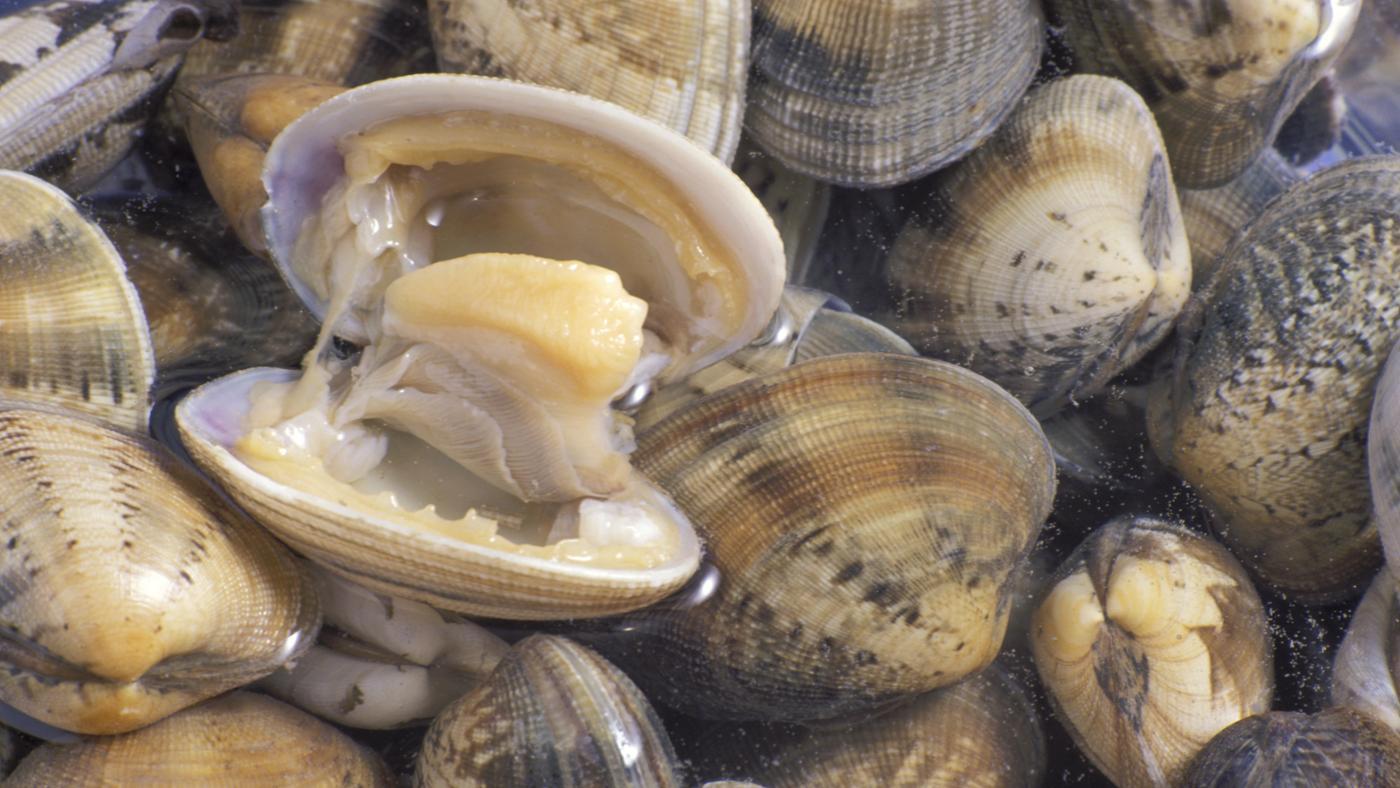
In this new letter, we understand that your request is to instead keep 500 clams in 3 different rooms. We appreciate the pun you made with “Amsterclam,” and that you say the clams have been inoculated for diseases. It is clear that you have taken steps to try and make this request as reasonable as possible.

Unfortunately, for similar reasons as your first request, we cannot allow you to bring 500 clams into our hotel. Even if the clams are inoculated, that doesn’t change the fact that they will create an unwelcoming environment for the rest of the guests, as well as being a hassle for our hardworking housekeeping staff that would keep them from doing their regular duties. While we do allow pets in our rooms, according to local laws, our team here at Amstel Hotel has agreed that 500 clams would exceed the allowance of creatures for the entire building.

Thank you very much for continuing to reach out to us. If you have any other requests, please feel free to run them by us first and we will let you know whether or not they are permissible. We hope that you are able to find some other alternative way to continue with your creative play ideas.

Sincerely,

Amstel Hotel Reservations

Featured

Professional vs. Unprofessional Resume

Purpose Statement: This blog post for the Writing 310 class compares two different resume styles, and explains which one is better for me personally to use.

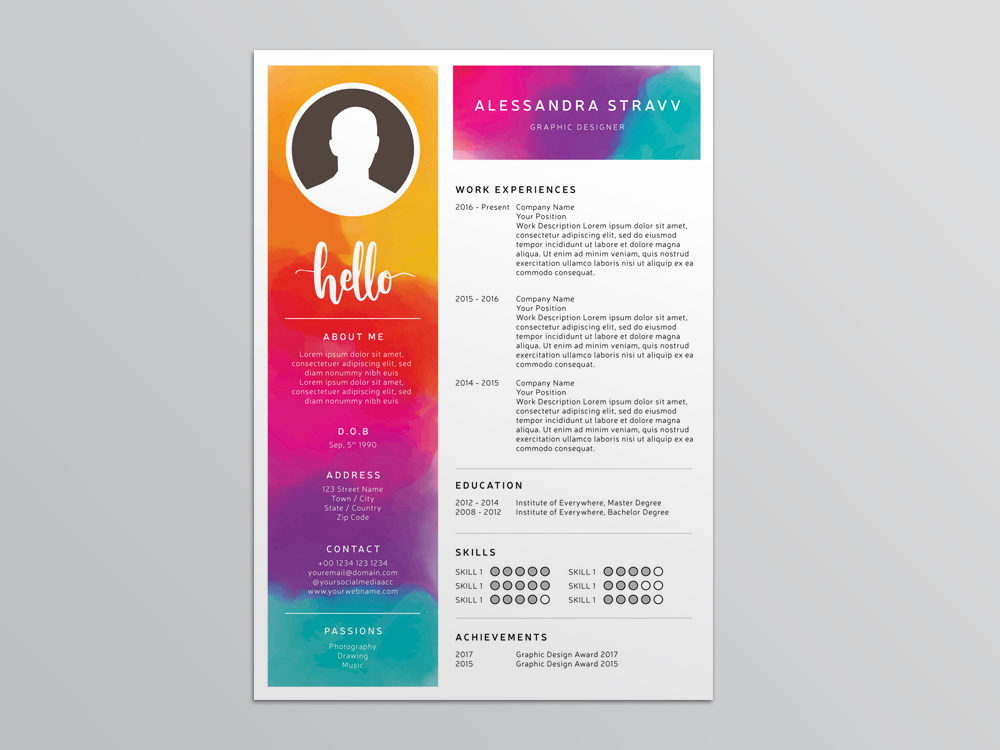
For this blog post, we were supposed to find two different resume styles and talk about which one is better for our professional goals. I want to be a writer and editor, so I need a resume that looks skilled and professional. The two styles I chose to compare were this style, and this style.

Style #1: A fairly bland looking resume that makes good use of white space, has user-oriented design in easy access to information, and looks well-made.

Style #2: A bright and colorful resume that catches the eye at first, but is clogged with needless information and trades professionality and functionality for initially pleasing aesthetic design.

If I were a graphic design major, an artist, or some other profession that may want rainbow colors popping off their resume, then obviously I would want to pick the second one. However, if I’m looking for a job as a professional writer or editor, then I would want the far more professional resume. It may seem kind of boring, but a good resume doesn’t need to be extremely interesting to look at. It needs to have the necessary information easily accessible. The rainbow resume looks good, but it’s confusing to find the information, and it trades space that could be used to convey why the applicant would be a good fit to catch the eye with bright colors instead. In the long run, it’s better for me to use the bland, professional resume.

Featured

To Use LinkedIn or Not to Use LinkedIn, That is the Question

Purpose Statement: A blog post for the Writing 310 class which answers the question, should I use LinkedIn?

Until going to college, I personally had never heard of LinkedIn. For my job searches, I would just google “Jobs in (City)” or use some job-finding site like Indeed. However, for this class we have been learning a little bit more about LinkedIn.

In this post I’m going to compare two different articles on whether or not to use LinkedIn. The first one is a professional source from Volume 118 of the Journal of Vocational Behavior, “Networking via LinkedIn: An examination of usage and career benefits.” This article is very steeped in academia, which is a polite way of saying it’s extremely dry and no good for casual reading, but I did get a few good quotes out of it in favor of LinkedIn. For example, “this study’s results demonstrate that networking online is associated with a wide variety of career benefits.” The article had an overall positive view of LinkedIn, saying that while it wouldn’t magically get you a job, it gave you a higher chance of getting professional connections.

The non-scholarly article I read was “LinkedIn is the worst of social media. Should I delete my account?” from The Guardian. The title is somewhat misleading, as it has positive things to say as well as negative about LinkedIn. It was full of complaints about the email spam and the people who use it for anything other than its intended purpose. Mostly, the author of the article said that it wasn’t good as a “social media” in the way that Facebook, Twitter and Tinder are social medias, but it sometimes worked well for its original intention, which was to find prospective jobs. “My investigative foray into LinkedIn suggested it offered more than merely a platform for congratulating friends on their ‘work anniversaries’ for a laugh. That’s not to say you should make it the sole site of your thought leadership, but the proliferation of recruiters on the platform means yes, it is advisable to have a profile with a recent picture, kept up-to-date and fleshed out with more than the bare minimum.”

So, comparing the two articles with each other, there is a fairly realistic view of LinkedIn. It isn’t guaranteed to get you a job, and the emails can be very spammy at times, but data and experience shows that it can be an effective tool to look for career options.

Featured

Personal Statement

Purpose Statement: This blog post is a personal statement about myself and my qualifications for the internship at Simon & Schuster.

Ever since I learned to read when I was 2 1/2 years old, books have been my passion. I spent my childhood reading and rereading my favorite books, and writing my own, and I’ve never stopped. I have had some professional experience with both editing and writing, and I hope to be able to learn more in this internship.

I am a fast and accurate writer, with typing speeds of around 93 WPM. I regularly achieve As in my English classes, and I often write for myself in my spare time. As part of my high school senior project, I began the process of writing a children’s book. Due to time constraints and extenuating circumstances, I never finished, but I was guided through the storyboarding process by a professional mentor. Heidi Schulz, a New York Times bestselling author, who has had three books published so far and many years of experience, taught me some of the processes of planning, storyboarding and writing a children’s book. This experience would be very helpful as a jumping-off point for the internship, having some background knowledge into what it is like to work as an author.

I have always had a passion for editing, including looking over my friends and siblings’ essays and correcting minor mistakes for them. Typos and grammatical errors pop out to me, whether I am reading a book or a text or an internet forum, and I am adept at fixing the issues that I find. My most recent employment was as an “Assistant Writing Fellow” for the LIBA 100 Freshman Writing class, where I got to put my editing skills to good use. I assisted underclassmen in planning, writing and editing their papers, as well as helping the teachers lead writing workshops among the students. This not only heightened my ability in editing, but helped me improve important soft skills such as communication and quick thinking. All editing interactions with students were in an online format, which has given me competency with using Zoom professionally. The formal editing experience I have received, along with my natural proficiency for it, would fit well with the editorial department internship. I would not only be able to use the skills that I already have, but work from there to gain more experience and knowledge into editing professionally.

I have a large amount of relevant experience for this position, and I am a quick learner who is eager to continue learning about editing and publishing as a career. My skills in writing, editing, and communication make me a good fit for this internship, specifically in the editorial department.

Featured

Job Skills Inventory

Purpose Statement: This blog post for my Writing 310 class lists and discusses some of the job skills that I have acquired.

I have had a variety of different job experiences that have given me a variety of different skills. Before I ever held an official job, I often helped my grandpa with yard work on his property in the country. He would pay me $10 an hour to rake hay or weed his garden, and doing that job for three or four hours a day every high school summer taught me how to maintain a high level of work activity. It was tempting to just sit there and listen to music and only work at half the pace instead of giving it my all, especially when I was tired, but if grandpa could tell that I hadn’t really been working then he wouldn’t give me the full amount of money. He believed strongly in work ethic, so I learned a little bit of that from him.

My first on-campus job was being a Phonathon Caller for the George Fox Advancement Offices, when I began going to college as a freshman. It was a job where students would call alumni, past faculty and student families, and ask for donations. It wasn’t an easy job, but I learned a lot. This job definitely helped me with my communication soft skills, such as meeting new people, taking independent action, and remembering information. I had to go off of a script, but also personalize each conversation to each stranger that I was talking to. In a three-hour shift, I would often hold ten to fifteen minute conversations with anywhere from ten to thirty people. While I’ll never work at a call center again if I can help it, those communication skills will definitely be useful in whatever job I have in the future.

The job I had last summer was a full-time job working at Walmart, eight hours a day, five days a week. That was another difficult job. Being on my feet for almost eight hours straight, constantly talking to customers, moving up and down, carrying heavy boxes, was a lot for me. However, I feel like it gave me a lot more valuable experience. I was able to provide customers with service, telling them which aisles to go to or helping them reach something on a top shelf. I endured long hours of work, and maintained records of item backstock and similar numbers. If I ever need to work in retail again, or even if I don’t, those skills will remain in my arsenal.

Probably the most helpful job I’ve had, in terms of skills I hope to use frequently in the future, was my job as an Assistant Writing Fellow last semester. I helped freshmen in the LIBA 100 Liberal Arts class with writing and editing their essays, and assisted course teachers with writing workshops. I determined and analyzed problems in the students’ writing and gave them advice on how to fix it. These writing and editing and communicating skills are the most similar to one of my prospective dream jobs, which is to work with an editing and publishing company. However, every single one of the jobs I’ve had has given me some skill that will be helpful in the future. A work ethic, thinking fast on the job, and persevering through long hours will be useful in any job.

Featured

Downtown Newberg

Purpose Statement: This blog post discusses observations of the downtown Newberg area that my professor and classmates can consider in the context of our class.

Observations:

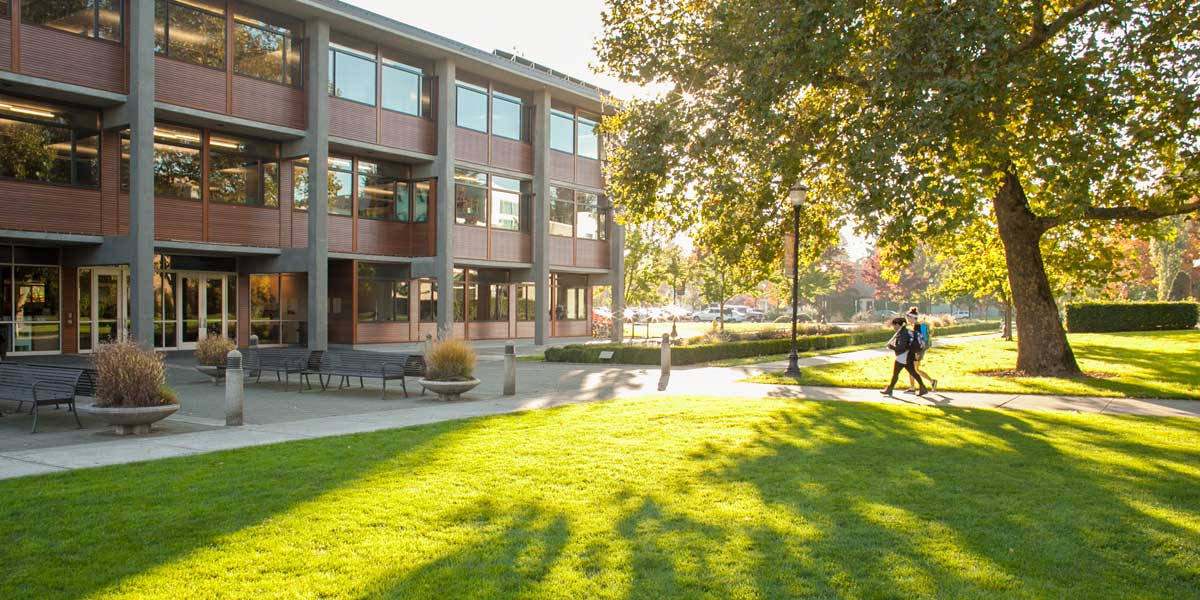
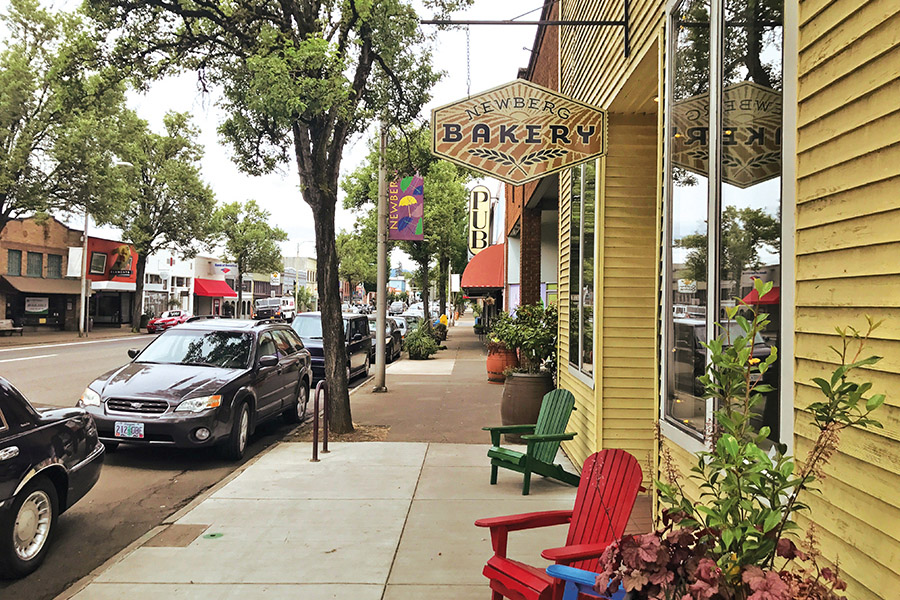
Newberg is a beautiful city, and it has a lot of wonderful places. The downtown area is one of my personal favorites, just to walk around and be in. As soon as you start walking down the street, you feel the area’s charm. The storefronts are well-kept, and many places have welcoming lights. The buildings are close together, so in the span of a thirty-second walk you pass a bakery, an antique store, a bank, and a coffee shop. No matter what you’re looking for, or even if you aren’t looking for anything in particular, you’re sure to find something you didn’t know you needed.

However, on the other hand, some of the buildings are old and worn down. The sides of brick may look ready to fall apart in a few more years, or paint may seem cracked and scratched. Most of these buildings are as old as Newberg, such as the City Hall, so a little bit of wear-and-tear seems inevitable. It’s really jarring, though, when you walk by a cute coffee shop and see a tall, off-peach building next to it that looks like it hasn’t been repainted in fifty years. Most of those are purely aesthetic problems, so the general vibe of the downtown area is still overall good.

I think that there are a few really good businesses in the downtown area that deserve more recognition. One of my personal favorites is the Gonzalez Taqueria y Panaderia, which sells tasty homemade Mexican food and pastries at really low prices. Off to the side a bit is also a business called Uflora, which sells house plants of many different shapes and sizes. I don’t personally have a plant, but I didn’t know until now that the shop existed– which is unfortunate, because it had a really charming feel and I’m sure anyone who wanted a succulent or an aloe vera plant would find whatever they needed there. I think a few businesses such as those can easily get lost in the cluster of welcoming storefronts, and so they could likely use a little bit of help promoting themselves.

Featured

Analyzing a Post from the Past

Facebook is a platform I seldom use, let alone post on. Usually I just use it to keep in touch with family members and see what they’re up to. Occasionally, if I have cool pictures to share or a development to announce, I’ll make a short post. The post I’m going to analyze, however, doesn’t really fit either of those categories: it’s a spur of the moment post I made more than half a year ago.

It’s warm and sunny outside. It smells like barbecue. My dogs are cute. No schoolwork till late August. Sometimes it’s nice to appreciate the little things, even in this chaos.” (May 2020)

Purpose:

The purpose of this post was really just for me to reflect, and to be optimistic. May of 2020 was a really hard month for me personally. COVID-19 had kicked me out of my dorm halfway through the semester, and though I’d just finished it, the pandemic showed no signs of slowing down. I used to think “oh, it’ll be over by April, maybe May,” but by that point I wasn’t sure. The rest of my family was worried as well. In this post, I focused on all the good things I could think of, trying to show myself and everyone in my “Friends” circle on Facebook (family members, friends, colleagues) that even in the face of the chaos happening, it was still okay to slow down and focus on the positive.

Audience:

As I mentioned before, the audience for this post was everyone I was friends with on Facebook. That circle is mostly my immediate and extended family, some of whom live far enough away that this is our only mode of communication. I also had a couple of friends, and some former classmates or high school teachers. Just a group of people I knew either deeply or on the surface level.

Stakeholders:

There aren’t really any stakeholders in this post– unless you count my dogs! It doesn’t really affect anyone. It’s just a short, positive message.

Context:

As I mentioned before, this was when America was really beginning to suffer from being in the throes of the pandemic. The “two-week” lockdown had been extended for an indefinite period. People were tired of being stuck at home. People were scared of the virus, and on behalf of their friends and family. I was hoping that if I tried to be optimistic in the face of the uncertainty, maybe I could help my friends and family be positive as well.

Featured

Bret Lott’s “Letters and Life”

In my Writing 200 class, we’ve been reading a series of essays from a book by Bret Lott, called “Letters and Life.” One of the essays I read was titled, “Why Have We Given Up the Ghost?” Its title doesn’t have very much to do with its contents, but instead Lott discusses his view on God and what writers, as Christians, should write about.

One of the things I thought was interesting about this essay was Lott’s view on the publishing industry. He names the publishing industry “New York” and calls it evil, saying that they are only focused on money. I’ve never tried to publish anything, but I can see where he’s coming from, with how difficult it can be to get things published if they won’t make good money. He says that instead of being focused on money, we should write focused on God. I also thought it was interesting that he put a lot of focus on not writing in our own wisdom, or assuming that we are wise, but letting God guide us in our writing.

Though the essay was interesting, it was also confusing at points, because he tended to ramble on with stories instead of spending time connecting them. He talked for a while about a miracle he’d experienced at a church camp, having enough gum and T-shirts for all the children when there were a lot more than he’d initially expected. He connected this with his earlier statement about believing in a “supernatural God,” but it didn’t seem to flow well with his rambling on about what writers should write about. Maybe I should just reread it and everything will make sense. Either way, I’m excited to read some of the other essays in the book, and I hope that they’ll connect a little better.

Featured

The Joy of Simple Tasks

I feel like people focus too much on achieving big, great things. Major accomplishments, sky-high goals, these are the things people like hearing about. However, I feel like we should place more emphasis on the happiness of completing simple tasks. Especially when you’re in college, learning how to be an adult, trying to focus on a hundred things at once, doing small things can be very good for you. For your consideration, I have compiled a list on some of the simple tasks I find satisfying, and that bring me happiness.

Cleaning my room– just living in a nice, organized space is satisfying. Having a little room of my own, where I know where everything is, feels nice.

Taking a shower– even though it feels like a lot of effort to get in and out, showers are important. Good for keeping you clean. They also feel really nice and warm (unless you take cold showers for some reason) and once I get out and get dressed, I feel 100% ready to do productive things.

Creating a schedule– especially when you’re in college. Not only is creating a schedule helpful to my daily life, but it makes me feel like a competent grown-up person taking care of myself. It’s so nice to look at the Google Calendar I’ve created and know what’s going on.

Driving somewhere– I personally just love the feeling of getting in the car. No matter where I’m driving, it’s nice to just sit alone in the driver’s seat, buckle in, turn the keys, blast some music, and drive off down the road. Especially if it’s in the summer and your windows are down. Especially if you drive on the highway. Especially if you’re going to have fun somewhere. But even in the middle of winter on a country road on the way to work, I enjoy driving.

Buying food– even just going to the store feels nice. But walking among shelves of food, picking out things that you want and need, then purchasing them, is wonderful. It’s just a little thing that feels so productive and adult-like, and satisfying. Bonus, I get to drive there!

Eating a meal I cooked– the act of cooking in itself is enjoyable. But then, sitting down to eat what you just spent time making is wonderful. Especially if the food tastes good. Even if it leaves something to be desired, you can look at the food in front of you and think “hey, I made this. I’m learning how to cook, I’m self sufficient.” If it tastes good, then even better.

Going to sleep– pretty self explanatory. Lying down in a comfortable bed at the end of a long day is satisfying and relaxing. Especially if it’s your bed, in your newly clean room, after a productive day of working and a delicious meal you made. Either way, getting in bed just makes the whole day worth it, so you can look forward to the next day.

These are some, but not all, of the small and simple tasks that I really enjoy doing. In times when everything is crazy, it’s important to find happiness in the little things.

Featured

The Book Industry’s Supposed Demise

The printing press was invented in 1440. For hundreds of years since, generations of avid readers have devoured books, keeping shelves in their home stacked with scores of leather bound tomes (and more recently, flimsy paperback novels), teaching their kids to read with primers and picture books. Recently, however, traditional book publication has begun to hit a decline. Publishing companies are losing money, self-publishing and e-books and audiobooks are becoming more popular, and the audience for books is rapidly dwindling. The book industry just isn’t what it used to be. Therefore, most statisticians predict its death, sometime within the next few decades.

As a lover of books, an aspiring author and an English major, this is vaguely worrying. A thousand fears could, and do, spring from these undeniable statistics. What if I can’t get a job? What if I write a book and no one publishes it? What if it is published, but no one buys it? What if my major is useless? What if since no one is writing, I can’t get an editing job? What if I can’t get physical copies of books anymore and I have to listen to audiobooks all the time?

However, all it takes is a few moment of thinking to put most of those fears to rest. Books will never truly die. Even if the publication industry shifts to e-books, which I don’t believe it ever will entirely unless we run out of trees, there will always still be an audience for reading. Even if the audience is smaller than in previous times, I can’t imagine the entire world leaving books behind in the dust as outdated or archaic. There will always be nerds like me who prefer the weight of a book in their hand, the smell of the paper, the sound of turning a page.

And, as long as people write, there will be editors. Whether those writers are journalists, or webpage authors, or book writers, they will need editing. Someone, somewhere, will be writing something, and it will need to be checked over for typos. Writers aren’t perfect, myself included, and people will always write. Therefore, there will always be a need for editors. I believe that is one of life’s true constants. Even if the book industry shifts somehow, I don’t believe it will ever truly die.

Featured

Ranking Comfort Foods

What constitutes a comfort food? According to Wikipedia, a reputable source if ever there was one, “Comfort food is food that provides a nostalgic or sentimental value to someone, and may be characterized by its high caloric nature, high carbohydrate level, or simple preparation. The nostalgia may be specific to an individual, or it may apply to a specific culture.” I’ve also heard people say that a comfort food needs to be warm, or needs to be cheesy, or anything along those lines. From my experience, it’s a specific food you can eat that makes you feel warm and fuzzy inside- whether from enjoyment of the taste, or happy childhood memories, or appealing to base human needs like the love of carbohydrates.

So, I’m taking what Wikipedia listed as “American comfort foods” and ranking them according to my personal tastes. Feel free to agree or disagree (in the comments if you want, or you can yell your opinion from the rooftops) but given that I’m sitting here on my laptop feeling hungry, this seemed like a good idea.

Tamale Pie | Valerie's Kitchen

32. Tamale pie
I’ve never liked tamales, so it stands to reason I wouldn’t like them in pie form either.
31. Grits
They’re very… gritty. I don’t like them either.
30. Red beans and rice
Okay, so I’m not from the South, which is probably why these are so low. I’ve rarely had them if ever, and they really don’t scream “comfort” to me.
29. Chicken soup
I know I’m in the minority here, but I’ve never really been able to stand chicken noodle soup (and other varieties). It’s soggy and salty and ruins its ingredients.

Ask the doctor: Why is peanut butter "healthy" if it has saturated ...

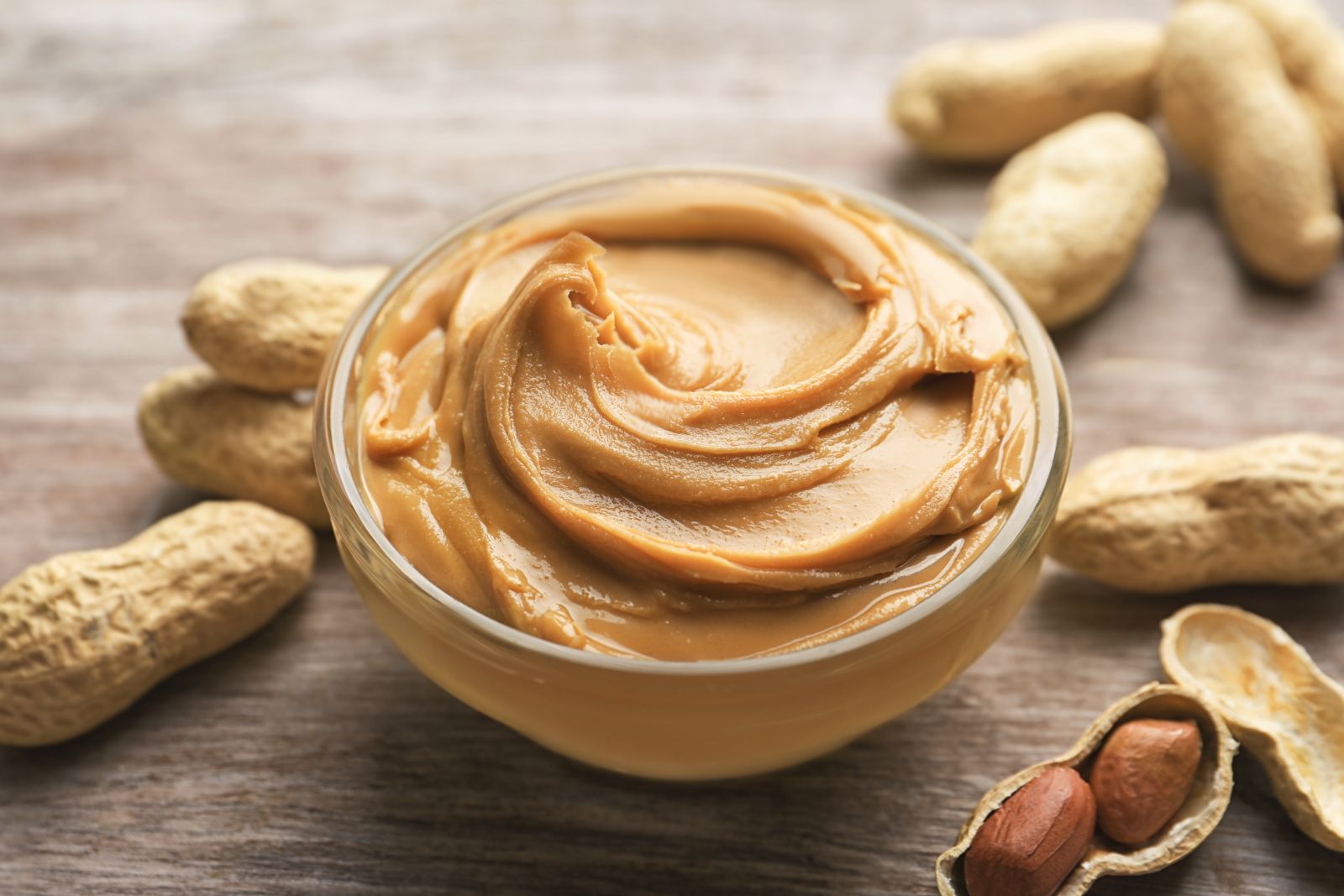
28. Peanut butter
Is peanut butter good with things? Yes. Is it a food, let alone a comfort food? I’d say no.
27. Pepperoni rolls
I’ve never really had these, but I imagine they’re kind of like hot pockets without all the sauce. Either way, I’m not a big pepperoni fan.
26. Chicken and dumplings
I’ve had good chicken and dumplings on occasion, but usually it’s a soggy lump of dough in sodium-drowned chicken.
25. Chili mac
Why would you ruin macaroni and cheese? That shouldn’t be possible.

Slow Cooker Corned Beef and Cabbage Recipe - How to Make Crock Pot ...

24. Corned beef and cabbage
There is a time and a place in my house for corned beef and cabbage. They taste really good on St. Patrick’s day. Any other time, I could take or leave them.
23. Chowders (Clam chowder, Shrimp chowder, Corn chowder, etc.)
I’ve had some pretty good chowder, and some pretty bad chowder. It balances out to “okay.”
22. Chili
I tend to like the red meat of chili (given that it isn’t too spicy) compared to chowder, but they rank about the same.
21. Cornbread
Cornbread is pretty good, but it serves as an accessory to chili.

Easy Homemade Sausage Gravy Recipe - How to Make Best Sausage Gravy

20. Biscuits and gravy
When done right, delicious. When done wrong, soggy.
19. Tuna casserole
As long as the tuna isn’t too overpowering, it’s warm and comforting. As a comfort food should be.
18. Casseroles
However, casseroles other than tuna (chicken, tater tot, etc.) are superior.
17. Green bean casserole
This is the best one though, it tastes like Thanksgiving.

Funfetti Cupcakes | Gimme Some Oven

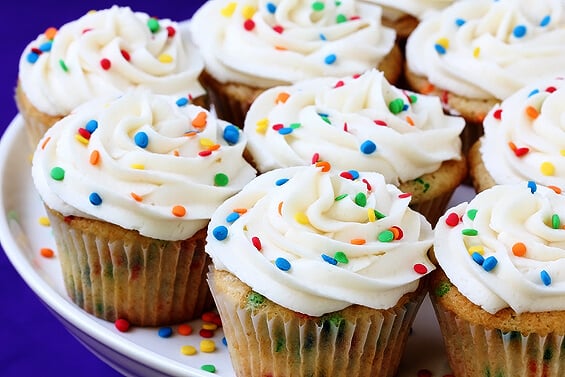
16. Cupcakes
Cupcakes can be really really good. However, they also have the occasional propensity to be nothing but artificial tasting cake buried under a mountain of frosting. Don’t do that.
15. Cake
Less likely to be buried under chemical frosting.
14. Chocolate chip cookies
If the cookies are fresh? Definitely a comfort food. Warm, melty chocolate chip cookies are heaven.

Menu - Pizza, Sides, Desserts & More | Papa John's

13. Pizza
A true childhood staple. Carbs, sauce and cheese. Delicious.
12. Pot roast
When well cooked and tender, this is definitely a comfort meal. However, it’s usually paired with another food that ends up higher on this list.
11. Meatloaf
Something about this is just really delicious to me. Sure, it’s a vaguely concerning brick of meat slathered in ketchup, but it’s a brick that reminds me of childhood.
10. French fries
Take a slice of potato, fry it in oil, add copious amounts of salt, and you have one of the true American foods. Good from fast food, or even better homemade. Best with ketchup.

Easy Steak Burrito Recipe | Just Microwave It

9. Burrito
The question: How many things can we stuff inside a tortilla? The answer: yes. Preferably with guacamole.
8. Apple pie
Another “American” food, and one of the most comforting desserts. Tart apple and sweet crust pair well together. My mom is really good at making this, so it ranks especially high for me. Especially good if you add caramel, or make it a la mode.
7. Fried chicken
There’s something so homey about the crunchy, salty outside of fried chicken paired with meat inside. It’s an all-purpose meal that never fails to fill you up.

Chicken-Fried Steak Recipe by Holly Van Hare

6. Chicken fried steak
Fried chicken, but better. Especially with gravy.
5. Ice cream
One of the most customizable, all-purpose desserts ever to exist. Ice cream is the one dessert I could never possibly get tired of. Tillamook is the best variety, but any chocolate or cookie dough flavor is among the best. And vanilla pairs with anything.
4. Lasagna
While homemade lasagna is otherwise my favorite meal, I’m ranking meals by comfort food, not by how much I love them overall. And also, so many people have only ever had the frozen stuff that won’t hold a candle to lasagna’s real potential. Lasagna is amazing, but doesn’t get the #1 spot here.

Ultimate Grilled Cheese & Soup · Friendly's

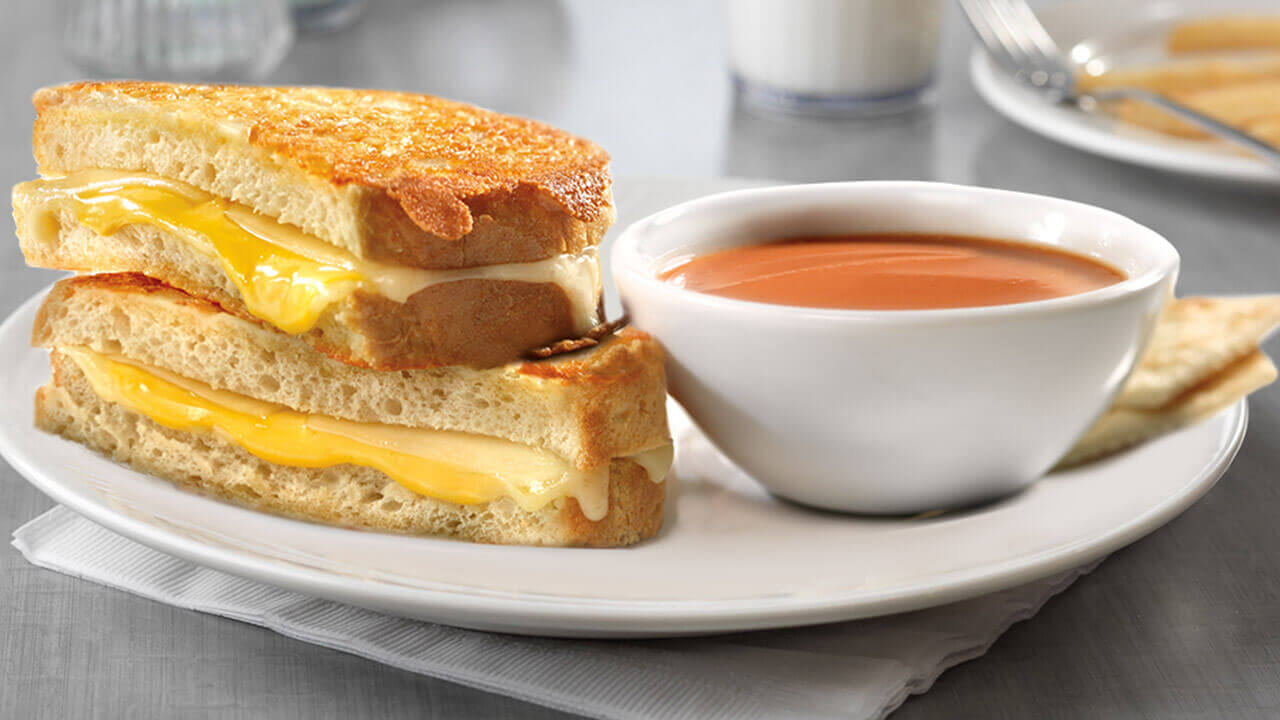
3. Grilled cheese sandwich and tomato soup
This is when it gets hard- my three favorite comfort foods. Grilled cheese really gets the cheese fix, especially when you use the right cheese (cheddar). Tomato soup is essential to the combo, and really sets off the simpler flavors of the sandwich for a heartwarming and unmistakably comforting food.

Slow Cooker Mashed Potatoes With Sour Cream and Chives Recipe ...

2. Mashed potatoes
Something about the creaminess of mashed potatoes is impossibly amazing. You can add almost anything- sour cream, garlic, etc.- and it will work well with the comforting carb base of potato. Please, please, do add gravy. It’s delicious. Making a volcano of gravy with mashed potatoes is an absolute staple of childhood. A perfect addition to any meal, but not necessarily a meal in itself, and so it doesn’t quite make it to the top spot.

Baked Mac and Cheese - Dinner at the Zoo

1. Macaroni and cheese
I’ve already written a post about how I think mac and cheese is best to be enjoyed, at my blog post you can find here (https://dorathywriting.poetry.blog/2020/02/06/the-process-of-macaroni-and-cheese/), so now I’ll just talk about its merits in general. To quote from the post, “it’s warm, cheesy, gooey, filling, reminds people of their childhood- it ticks off any and all boxes for comfort food that could be ticked.” It’s everything you could want in a meal and more. And if it isn’t, there are infinite possibilities! Want meat? Add meat. Want different sauce flavors- hot sauce, barbecue sauce, tomato sauce? Do whatever your heart desires! Macaroni and cheese is the ultimate, #1 comfort food.

So, that’s my imperfect listing of my opinions on comfort foods. What’s your favorite comfort food? Did it make the Wikipedia list? Did I rank it incorrectly? Let me know in the comments!

Featured

The Princess Bride: Book vs Film

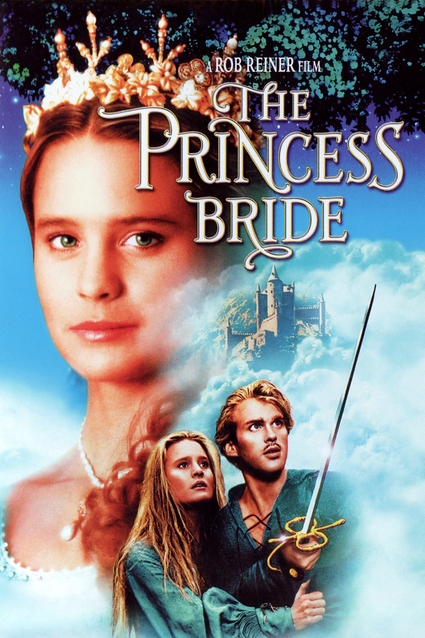
“The Princess Bride” is one of the most famous cult classic films, and a personal favorite of mine. Something about the epic fantasy, laugh-out-loud humor, and quotable characters make it easy to rewatch again and again. It’s well known, full of lovable actors and lines, and there’s a sense of magic to it that doesn’t go away even when you know the plot like the back of your hand. However, many people don’t know that the movie is based on a book of the same name by William Goldman. The book came out in 1973, and the movie came out in 1987. The movie is remembered far more than the book, despite the fact that both are good.

Many people say “the book is always better than the movie.” However, in this case, I would argue that “The Princess Bride” film is better than the book. Both are really, really good, and I do enjoy the book. However, there are a few things that the movie does better or improves upon.

  1. Visualization- the one thing that movies will always hold over books is the striking ability to make people visualize. When reading a book, characters and settings are up to the person’s imagination, but on a movie screen those ideas come right to life. Seeing the beautiful princess Buttercup, handsome farm boy Wesley, dashing Man in Black, evil Vizzini and Prince Humperdinck and Count Rugen, even the terrifying Fire Swamp, really makes the story come to life.
  2. Actors- the actors and actresses in this movie are phenomenal. They really sell their parts. Prince Humperdinck is hammy, the Man in Black is suave, Fezzik is innocent and kind, and Vizzini is hilarious to watch. However, the best actor is probably that of Inigo Montoya, who delivers with perfect drama the most-quoted line of the series: “Hello. My name is Inigo Montoya. You killed my father. Prepare to die.” The fencing scene between him and the Man in Black is suspenseful and well-shot, for both fencing aficionados and those who know nothing of fencing. The way he carries himself and his facial expressions really sell the character. All the actors and actresses here are wonderfully cast and play their parts well, but he is the best.
  3. The narrators- the book and the movie somewhat differ here. In the book, the whole story is constantly broken into by William Goldman, who is supposedly translating and editing boring parts out of the original version and putting witty comments in their place. This is funny and and enjoyable, but occasionally removes you too far from the actual storytelling. In the movie, it is read by a grandfather to his sick and bored grandson, who goes through character development by learning to like books and not disparaging his grandpa for reading to him. The characters are believable and don’t detract from the actual story, though it does cut away once or twice for a short conversation between the two. Instead, it keeps us engaged with both the main story and the side narrator characters, and there is a good payoff for both in the end.
  4. The ending- SPOILERS for the book and the movie. In the book, the ending is somewhat mitigated by a few downer sentences after the “happily ever after” kiss. While there is some hemming and hawing in the book’s satirical author’s notes about whether that is actually the ending or not, it brings down the whole epic fantasy aspect by making it realistic. (If I wanted a realistic story ending, I’d be reading one.) The movie does no such thing, instead giving us a realistically happy fairytale ending for the characters of the story, and a happy ending for the narrating characters as well. It fits the rest of the tone much better, as opposed to whiplashing to a “but is it actually happy? Did they really win?” ending like in the book.

These are the reasons that I like the movie better than the book. However, I strongly recommend both. If somehow you haven’t seen “The Princess Bride” yet, what better time than quarantine to introduce yourself to this classic? If you haven’t read the book, then- well, libraries near here at least may be closed, but we have ebooks and audiobooks galore. Reading time abounds! Treat yourself to a really fun book, especially if you like sarcastic narrators.

Featured

Animal Jam: Revisiting Childhood

When I was a kid, my parents didn’t let us have any video games. No Xbox, no PlayStation, no GameCube- we didn’t even have smartphones. This meant that the only games I played as a kid were either at a friend’s house or, more commonly, online. Some of these were educational games that taught things like multiplication and keyboarding. Others were completely fun-focused time-wasters that I loved with every bit of my middle school heart. Of these, the nearest and dearest to me was an MMO (Massively Multiplayer Online game) called Animal Jam.

Animal Jam was released in 2010 by National Geographic, and has been going strong and gaining a cult following with children and preteens ever since. It masquerades as being “educational” by containing the occasional fact about animals, but children (such as I) would eagerly skip past these facts to get to its more entertaining aspects.

A relatively simple game, Animal Jam is so-called because the avatar you play with is an animal. It’s set in a world full of animals called “Jamaa,” The original, smaller selection included wolves, tigers, pandas, bunnies, koalas and monkeys, but as it has grown in the years it’s existed, it now includes new animals like eagles and llamas, and variants of existing animals such as “spring bunnies”. The possibilities are endless. You pick an animal, name it, choose from several different colors and outfits, and then… do any of a million activities. You can play mini-games, bigger story-driven games called “adventures,” buy items, go to parties, decorate your “den,” and above all, interact with other players (called “Jammers”). It had a simple charm that would let you waste hours and hours on these activities. Of course, my parents never let me sit in front of the computer for more than an hour, but I loved those hours with a passion.

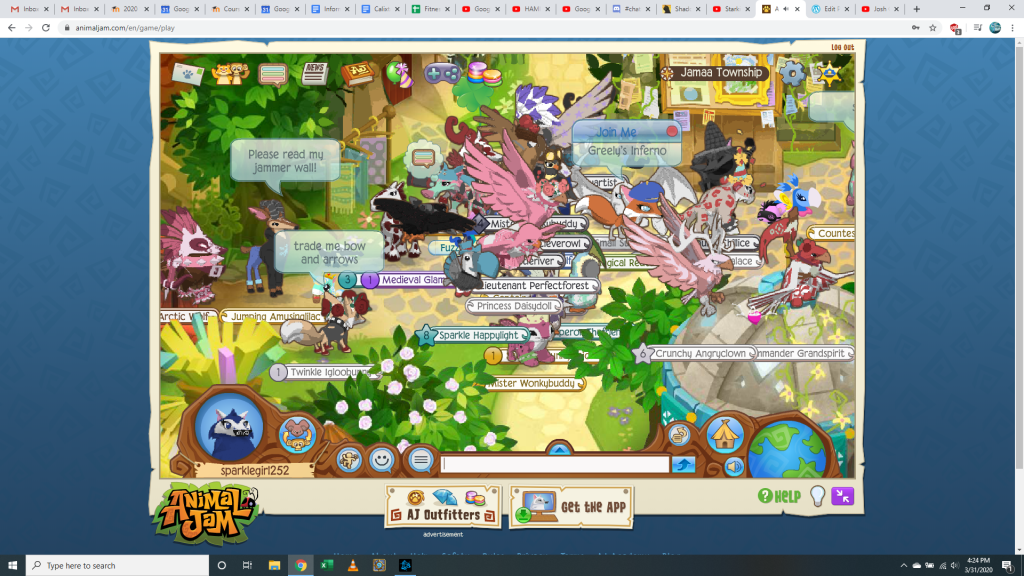
One of the most popular places in the game to hang out- Jamaa Township

The real trick to Animal Jam was that it was, technically, free. You could gain access to the fundamental parts of the game without buying anything. However, to get the coolest items, dens, animals and adventures, you had to be a “member.” Memberships cost $6.59 a month, $29.95 for 6 months, or $57.95 for a year. It seems like a deceptively simple amount of money at first, but National Geographic has made a killing with kids begging their parents for money to be a “member” in this game. I know that I was one of them (unfortunately for my poor parents). I got a membership once for Christmas, and then had to spend my own hard-earned money to get them later on.

I stopped playing the game when I was about 14 or 15, from more sporadic visits coming to a full halt, but it was still a big part of my childhood. I introduced my sisters to it, and the youngest ones still play it regularly, so it’s nice to occasionally walk through the house and hear the bouncy soundtrack that brings back happy childhood memories.

One of my many avatars

Something interesting happened this last week, though- my sisters excitedly told me that Animal Jam was giving out free two-week memberships to all its players, in homage to the fact that so many people are home during the quarantine. All you had to do was enter the code they gave you when logging in. They urged me to log into the game again, just to get the code and mess around for a week or two. I’m nothing if not a people pleaser, and I was also a little intrigued by the premise of revisiting this game that I used to spend so much time in. So yesterday, I logged back in to catch a glimpse of my childhood.

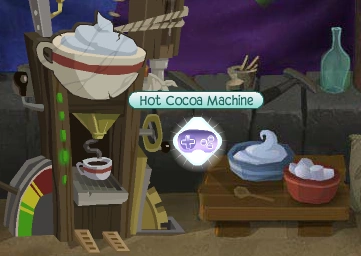
Nostalgia hit me like a ton of pillows. Even hearing the music that played as the game started up and the familiar little click sounds as I spun the “daily spin” wheel for a prize immediately brought back a flood of memories. Looking at all my old animal avatars, their names and clothes, everything I put so much painstaking time into, was really interesting. I hadn’t been expecting the emotional rush. Wandering the places I used to go- my den, the hot chocolate shop, the Crystal Sands beach, the arcade- reminded me of a thousand lost, forgotten hopes and dreams and cares I’d once had, all centering around this game. My inventory stocked with a thousand “rare” and “valuable” items I’d put in so much work to obtain… my outfits, carefully crafted to cultivate a certain feeling or look like another character I loved… my username, “sparklegirl252,” that I’d thought infinitely clever at the time… my dens, my animal names, my favorite games, my friends list, everything. It all flooded over me in a rush as I looked around the world I basically lived in during middle school. What a time.

The hot cocoa machine in my favorite hangout, Mt. Shiveer’s Hot Cocoa Hut

If any of you are looking for something to do with the massive amount of free time on our hands, if you have little siblings with the same problem, or if you ever spent a crazy amount of time on this game like I did, then I urge you to log in again and just spend a little bit of time in this innocent, animal game filled world. I had a good time, and I’ll probably come back every once in a while if I need cheering up. Revisit something you did in your childhood- it’ll do you a lot of good.

Featured

Covid State of Mind

All the media is talking about the Coronavirus, or COVID-19, and I guess I’m going to join their ranks since it’s pretty relevant and the only thing I can think of right now. I should have written this post earlier, but oh well.

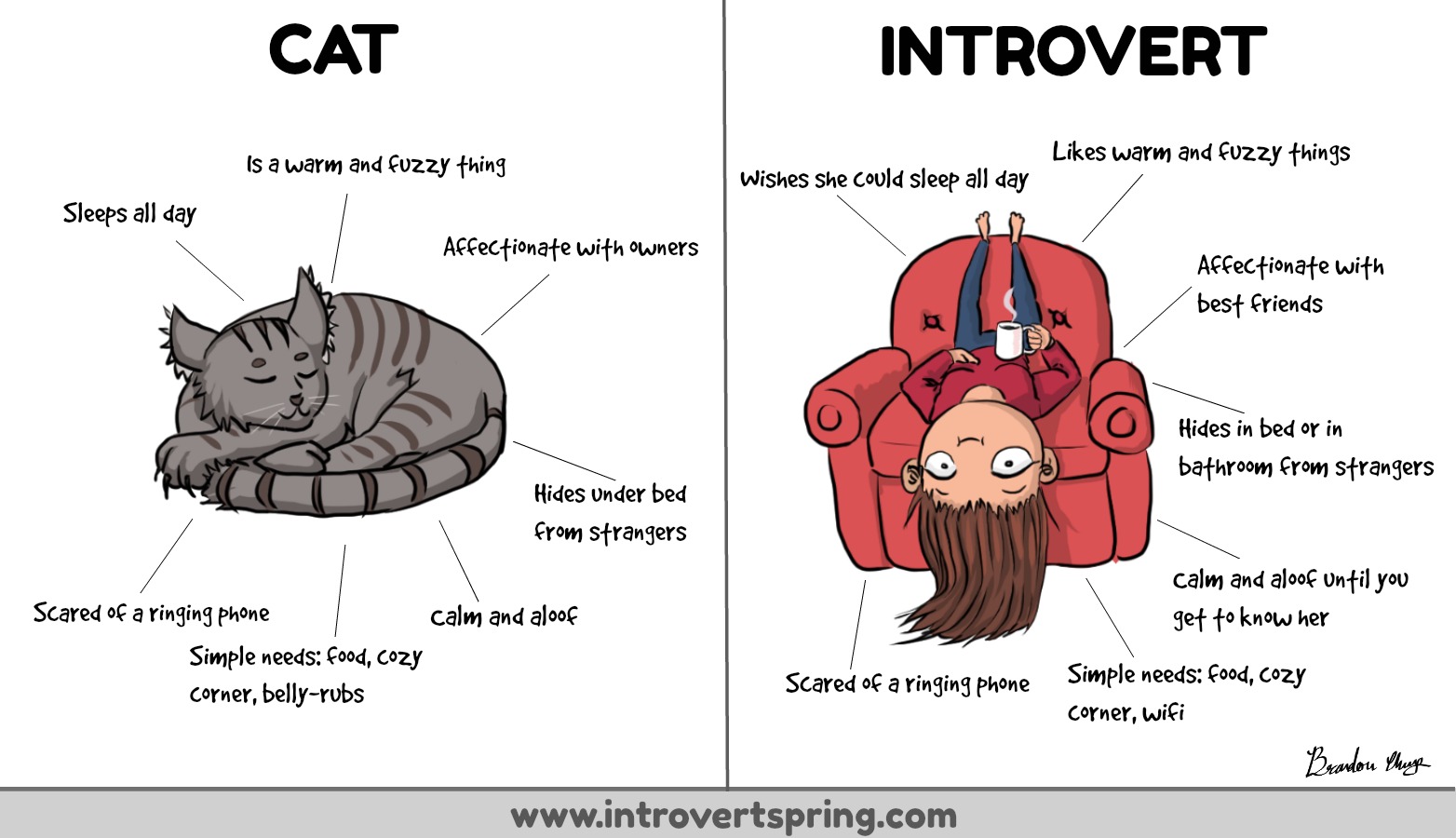
Due to the Coronavirus, I’m going home a week early for an extended Spring Break. There are pros and cons to this. Cons- I have to share an already-cramped room with my sister, live out of a suitcase, and probably stay inside a lot of the time. Pros- I get to spend time with my family and dogs and boyfriend (who’s coming to my house for the break), have less homework, and probably stay inside a lot of the time. Hey, I’m an introvert, so I’m not too horribly personally upset about the lack of traveling. The break will be nice… we’ll see about after it.

I will admit, though, it’s kind of scary. We haven’t had a pandemic like this since the Spanish influenza in 1918. The disease itself isn’t necessarily what scares me- it’s the panic. People panicking everywhere. Back in my home town, the lines at Safeway stretch around the entire store. There’s no toilet paper to be found. People are locking themselves away and will freak out if someone sneezes or coughs. While the disease is dangerous, moreso is the complete and utter panic that is sweeping the nation. I think if we can get people to calm down, wash their hands, only buy what they need, and breathe… then we’ll be all right when the virus reaches us.

Stay safe, everyone.

Featured

Necessity of Grammar

In our class this week, we talked about formal grammar instruction, and whether or not it’s necessary to learning how to write. Some people were of the opinion that it is absolutely essential, whereas others said that it wasn’t important at all. I personally landed somewhere in the middle of the debate, but closer to the importance of teaching grammar in school.

I think formal grammar instruction should help a developing writer learn the writing skills they need. While a writer’s work doesn’t have to be perfect, it does have to be coherent, and grammar instruction should help with that. Learning about grammar and how to use it definitely helped with my writing technique. I got most of my knowledge from books, then when I went to school I learned officially how to use most of the rules I’d already seen. Books are very helpful to see rules used in context, but it isn’t a perfect way to learn. For one thing, many books break some grammar rules in order to make stylistic choices. That makes it difficult to tell when a book is or isn’t being correct. Also, seeing a word spelled is no substitute for hearing it pronounced out loud. Mortgage, (mor-gij), colonel (kernel), queue (q), choir (quire), etc. I thought it was pronounced “choir,” like “chair” but with an “o,” for the longest time…

It is possible to not be taught proper grammar in school and still be an excellent writer. However, writing becomes much easier if grammar was taught. While all writers have information in their heads that they want to put down, if they don’t have the means in their head to do so easily, then the actual act of writing can get in the way of the spirit of the story. If you have a great description scene you want to write, but you can’t remember whether your sentence structure is correct, then the story suffers for it. So while it isn’t impossible to be a good writer without being taught correct grammar, it is much easier to have the background knowledge.

Featured

The Effect of Gender on Writing

Writing is influenced by a lot of different things. One of the most common influences that people wonder about, however, is gender. Does being male or female affect the style or content of your writing? After reading a couple of articles and just looking at what I see in the world around me, I think that it does. While it does affect your writing, however, you aren’t born with a specific mindset towards it based on your gender. Instead, it has to do with how people are treated and raised.

One essay I read, “Composing as a Woman” by Elizabeth Flynn, posed the theory that women’s writing tends to be more focused on relationships and emotions, and men’s writing tends to be more about success. This hasn’t been my experience. But if it is true, it’s probably because of how men and women are raised and taught to write. From a young age, men are often taught that they need to be successful. They have to build their lives around picking a good career, getting a stable job, having a good financial situation, etc. With that constant pressure, I would imagine that success would take up a considerable amount of their brain space- and would therefore leak into their writing. Women, on the other hand, tend to be treated as more emotional, as well as being taught more relational skills by their mothers. (This is just completely generalized, and I realize that in a personal sense for most people it wouldn’t always be true.) Therefore, that bleeds through into their writing as well.

I think gender is probably one of the many things that factor into a person’s writing, but I wouldn’t say it’s as black and white as “women are emotion based” and “men are success based.” There are certainly some elements of that, but it is definitely more from the individual’s upbringing than anything else. I have seen very success-focused pieces written by women, and very deeply emotional and relational pieces by men, so none of these are set in stone. Gender does have an effect, but the effect it does have definitely varies.

Featured

My Dogs

All right, you’ve heard enough stories about me. Now it’s time to hear about the really important people- my dogs.

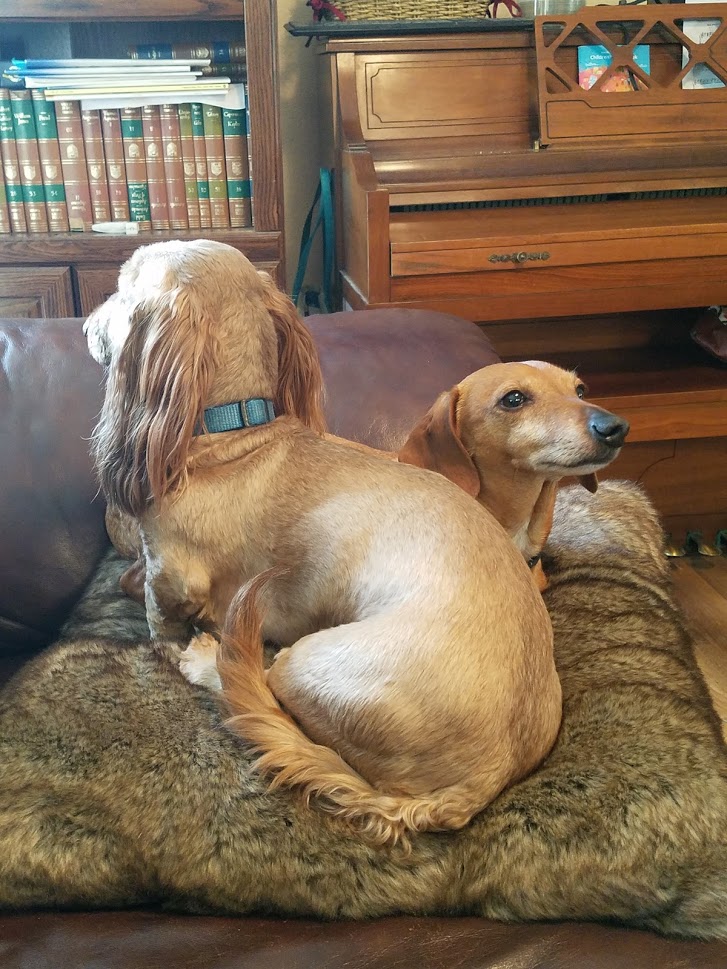
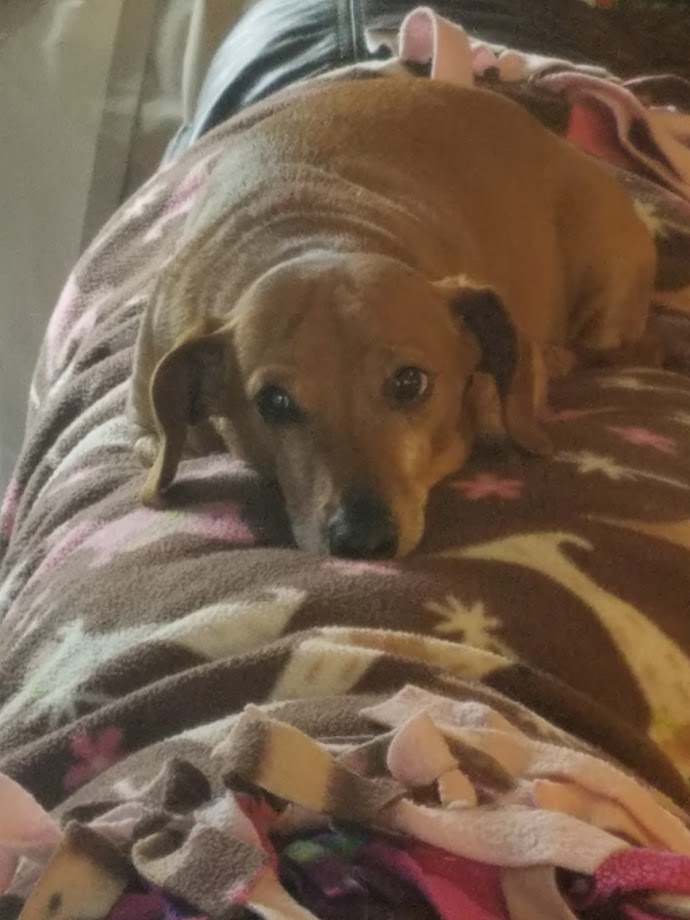
I love my dogs. They’re both dachshunds, and they’re best friends.

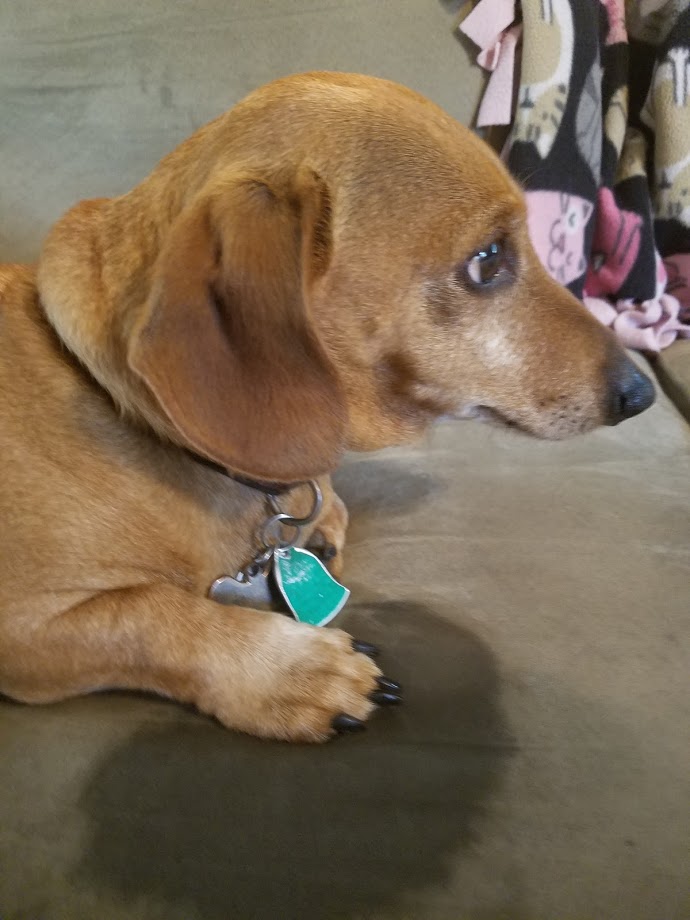
(If you’re wondering why the couch has a wet spot, it’s because he was licking the couch. He does that, for reasons unfathomable.)

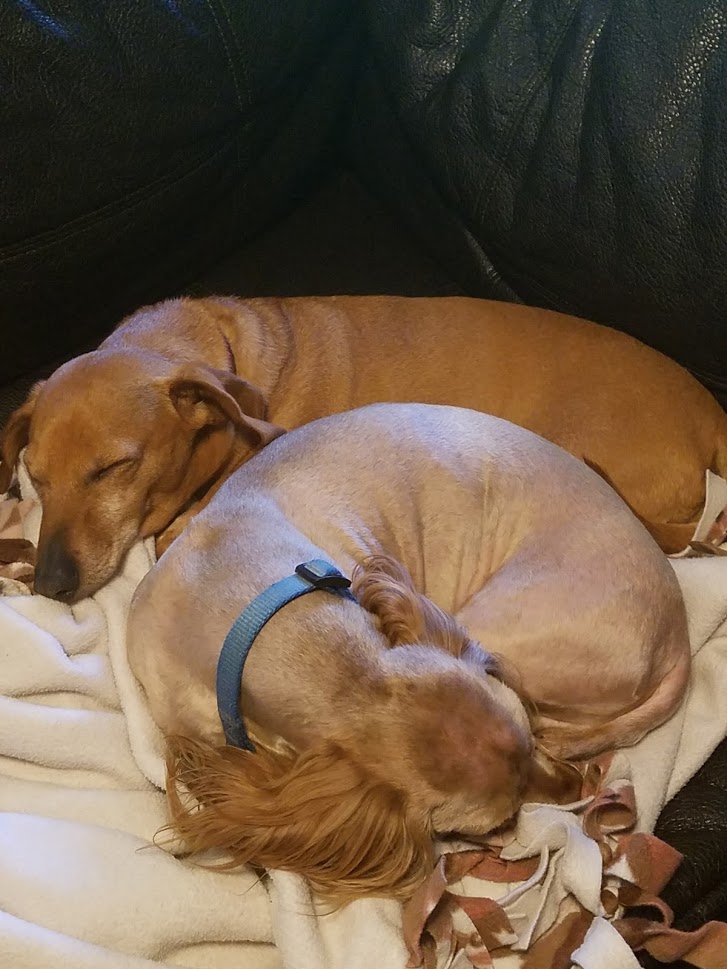
This is Frankie, short for Frankfurter. He’s the older of the two, at roughly 8 years old. He’s a purebred smooth-haired mini dachshund. We got him as a puppy. My mom found him on Craigslist for $100, which is actually pretty cheap for a purebred. He was the last of his litter and the seller wanted him off his hands. So we took him home in a little box and he’s been home ever since.

He’s the quieter of the two, partially due to his age. He’s fine with lying around all day, sunbathing in rays of light from the windows, curling up on a pillow exactly his size or burrowing into a blanket like a burrito. Dachshunds were bred as burrowing dogs, to sniff out badgers and other tunneling animals, so both dogs like to burrow into blankets and lay completely wrapped there. We’ve learned not to sit on blankets unless we check to make sure there’s not a dog in them first.

Living his best life.

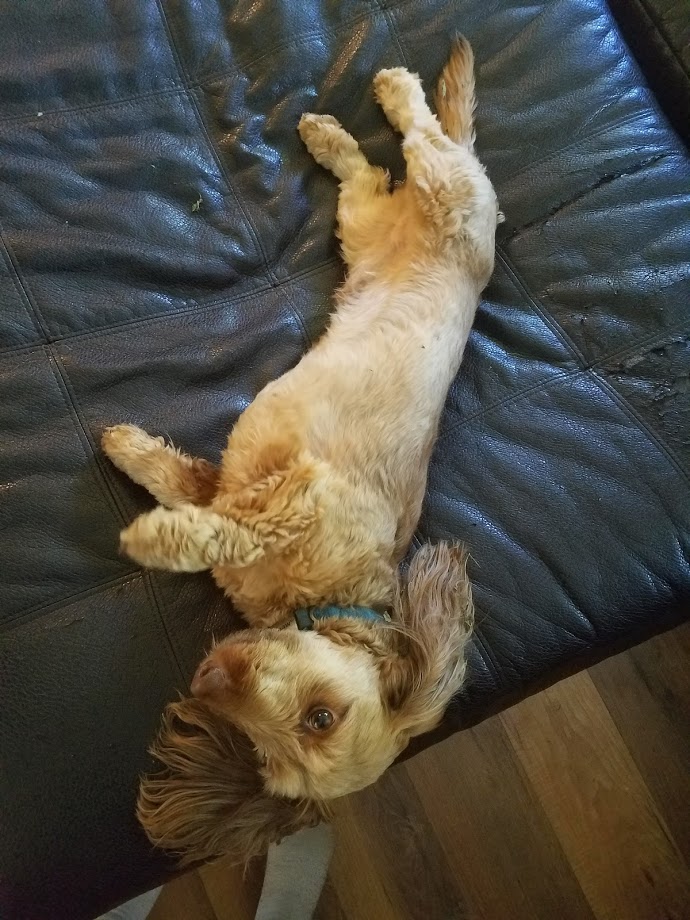
This is Chewie, short for Chewbacca. He’s younger, barely older than a puppy, about 3 years old. We have no idea if he’s purebred or not, but he seems to be at least mostly wire-haired dachshund. Their hair grows a lot longer than this, but we trim his fur so that he doesn’t become an absolute mop of muddy tangles. He’s a rescue- we weren’t planning on having another dog for a little while, even though Frankie was beginning to get lonely. There’s a story behind how we got him.

My older brother used to mow lawns and do yard care as a side business. One of the families he worked for had a really muddy, sad-looking dog who would follow him around the yard to be petted. One day, the owners of the property saw him petting the dog, and asked if my brother wanted him. If not, they said, they would be taking him to the pound. The dog had been a gift for their daughter, who hadn’t wanted to take care of him, so they’d just been leaving him outside and not really paying him any attention. My brother said he’d have to ask my mom, so he did. I was with my mom when she got the phone call, but I don’t remember her exact responses. I can only imagine what my brother would have said: “So, heyyy, Mom… do you want another dog?”

Long story short, we ended up taking him in, trimming his fur, and adopting him into our family. He and Frankie didn’t get along at first, but once Chewie learned not to play with the older dog’s toys or steal his food, they got along fine. Now, they’re best friends, practically inseparable.

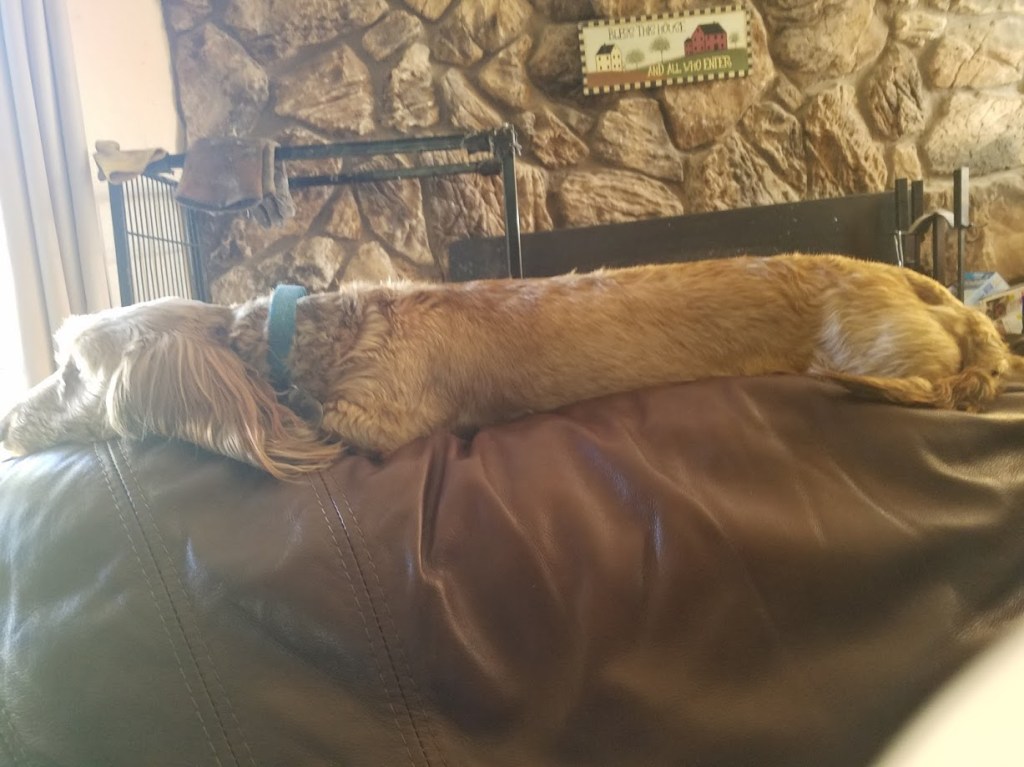
Whereas Frankie can lay around all day, Chewie is a rambunctious bundle of energy. He’s a complete wild card. Half of his time on the couch is spent draped across the back like a cat, or attentively looking out the window for the slightest sign of a squirrel. If he sees one, he’ll whine at the door until one of us lets him out, and then he’s off like a speeding, barking bullet towards the rodent. He can stay by the fence for hours, running back and forth, watching the squirrel. If he starts to lose interest, the squirrel will taunt him, running along the fence and waving its tail and chattering at him. Sometimes Frankie will run outside and bark with him, but lose interest and go sniff around elsewhere after a minute or two.

Chewie is also a notorious digger. We have a garden in our backyard, as well as a good-sized lawn… but some parts of it are absolutely riddled with holes. He doesn’t even usually dig to bury anything, he just enjoys it. Unfortunately for everyone, Oregon is often muddy, and so he’ll come inside with his entire front legs and chest completely caked in mud (or, in the dryer seasons, just dirt). He is a master at getting into trouble. One time, he ate a garter snake in our garden- then promptly threw it up all over my Mom’s nice new rug. Then he spent the rest of the day outside.

Look at this smile. It’s the smile of an unashamed criminal.

Frankie has his own moments, though. For one, he absolutely despises water. This means whether it’s going outside in the rain, or being forced to have a bath, he’ll try to get out of it. If we ask him to go outside while it’s raining, he’ll just stare despondently out the door until we gently place him on the doorstep. If we even say the word “bath,” he runs and hides in his bed until we pick him up to put him in the sink and wash him. The most scared I’ve ever seen him of water, however, was when we took him to the beach. He was having fun at first, tearing up the sand, sniffing at seagulls, looking around at all of the sights to see and scents to smell. Then, he saw the ocean. His claws dug into the sand, he stopped abruptly despite the pull of the leash, and absolutely refused to go any further. I could practically hear him thinking, what is this? Why have you brought me here, to the mother of all bathtubs? He stayed far away from the ocean for the rest of the beach trip.

He likes to lick our hands. And faces. And everything else.
They also lick each other, not just us.
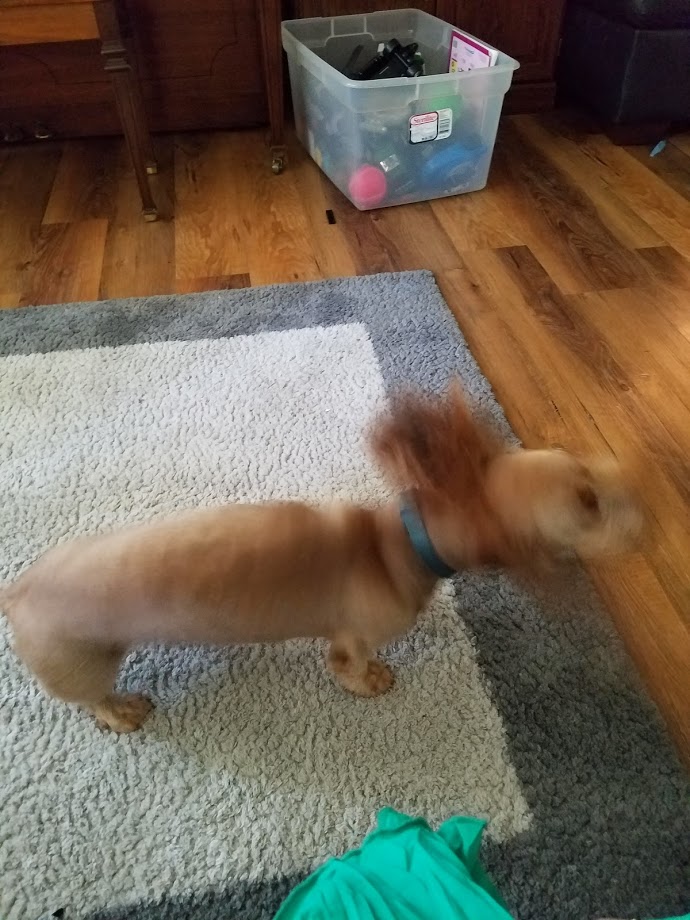
Caught in the act of shaking his cares away.
He looks so round from this angle… definitely the chubbier of the two.
On squirrel watch. Look how long he is!
Best friends!

I have a ton more stories and pictures I could share, but I think I’ll try and keep this somewhat brief. Suffice it to say, I love my dogs, and they love us, and they love each other. I really miss them and I can’t wait to see them over Spring Break.

Featured

Dungeons and Dragons

Yes, I am a nerd. I’ve played Dungeons and Dragons (a tabletop roleplaying game with dice, for those of you who don’t know) for close to five years now, and it’s something I really enjoy. My nerdy uncle first introduced me to the game, then my brother let me join his group… where I was the only girl. But I love the active storytelling involved in the game. You get to play as a character that you create, who can be any race from a human to a half-orc and any class from a wizard to a barbarian. It’s like writing a book, but you do it aloud with several other people, and you’re one of the characters! If you’ve never played it, I suggest you try it out. We have a club here on campus that I’m a part of, the Critical Hit club, and there are some really good DMs here (Dungeon Masters, the “authors” of the book- the people in charge of describing what happens, writing the story, and playing every other character). It’s a really fun club, and an awesome environment to be part of.

This story is from a D&D campaign that I played in last semester. Probably not completely accurate detail-wise, but the general story is the same. It’s just a little snapshot of the kind of chaos that can go on in our party (group of players). Maybe I’ll share other stories later, more epic stuff that shows the awesome story-building that goes into the game, but for now I’ll just write this funny story that happened because of a bad perception roll.

Our party was just settling in for the night, making camp in an abandoned distillery that we’d come across. We were traveling across the isle of Armien, but couldn’t make the entire journey in one day, so we had to stop and rest. The distillery was wooden, a cellar that went down underground. There was a staircase that connected the top and the cellar, where barrels of beer were stored. The party was camping down in the cellar.

When you’re in D&D, a world filled with monsters, sleeping without a sentry is a very bad idea. Zombies could sneak up on you, people could steal your stuff, anything could happen. So we always had someone keep watch. In this case, the first person on watch was a character named Jared- a young necromancer (wizard with a focus on raising the dead). He stood alone in the top room of the distillery, in the dark, looking nervously around to make sure that no monsters were coming in. The DM asked him to make a perception check.

(Quick explanation on how these things work: in D&D, things that you do are determined by rolls of the dice. When your character is going to perform an action, you roll to see how well you do. If the number is high, you do well. If the number is low, you fail. If the number is somewhere in between, then it depends. Different characters have bonuses they can add to things, but a lot of the time it comes down to luck.)

Jared’s player, Maddie, rolled a D20 (20 sided die). I don’t remember the exact number she got, but it was somewhere in the single-digits, which wasn’t great.

DM: “You aren’t sure, but you think you hear the door creak. It’s slightly open.”

None of the rest of us could remember whether the door had been open before. However, none of that mattered, since our characters weren’t awake. What would happen was up to Jared. One of the fun things about D&D is that you play a character, so you react how your character would, according to their personality. Unfortunately for everyone, Jared was a scaredy-cat. He immediately panicked and raced down to the distillery, waking up the first person he encountered: my character, Phoenix, who was a sorcerer with a love for fire spells.

Phoenix (grumpily): “What?”

Jared: “There’s someone up there.

Phoenix: “What?”

Jared: “I’m on watch. The door opened. There’s someone there. Help.”

Phoenix got up and began to walk up the staircase, Jared behind her.

Again, here’s where the fun comes in: playing characters based on their personality. If I was trying to play a character based on what I, the player, knew was the best thing to do in the moment, then that would take a lot of the fun out of the story. Instead, I took into account how Phoenix was at the moment. It was sometime around the middle of the night, she was groggy and not fully awake, and therefore not thinking straight. These thoughts all factored into the action I decided to take. If I was being smart, Phoenix would have gone carefully to investigate, maybe drawing a weapon or finding a lantern somewhere. She had an ability called “darkvision,” which meant she could see fairly well for short distances even in the dark. However, since she was sleep-deprived and not the smartest to begin with, she did something dumb.

Me (grinning, knowing this is a bad idea): “I cast Burning Hands.”

The DM and the rest of the party, collectively: “Oh no.” (And several variations thereof.)

Burning Hands is a spell that covers the user’s hands in magical flame. It functions like normal fire, except it doesn’t actually hurt your hands when you cast the spell. Phoenix’s thought process was that casting the spell would help her to see, using the fire to illuminate her surroundings and shine some light on whatever intruder was freaking Jared out. However, there are a couple of factors that make this a bad idea:

  1. She is in a wooden building.
  2. It’s a distillery. Filled with alcohol.
  3. Both wood and alcohol are very, very flammable.

So, of course, part of the staircase immediately caught on fire.

Thus, everything descended into chaos. Phoenix stood there, dumbfounded, trying to figure out what to do. Jared ran around like a chicken with his head cut off. A few more members of the party then woke up: Guardian, an armor-wearing paladin (fighter with power from a god), Bertram, a stuck-up cleric (spellcaster with power from a god), and Soos, a druid (spellcaster focused on nature and animals). Guardian added to the chaos by trying to put out the fire by hitting it with his warhammer. (His player was also making bad decisions based on the character’s personality.) Bertram stood back, snidely commenting on how dumb it was to start a fire in a distillery. This led him into an argument with Phoenix, who got offended easily and already wasn’t in the best mood. They never got along, and this was no exception.

So two people were fighting with each other, one person was panicking, and another person was chopping up part of the wall. Fire was still spreading. In the midst of this, the druid Soos spoke up.

Soos: “So, um… Do you guys want me to cast Create Water or something?”

Everyone (in collective exasperation): “YES!”

Create Water is exactly what it sounds like: a spell that creates a quantity of water. Instead of immediately solving the problem, the druid stood there for a while, lost in the chaos, and then asked if casting the spell would be a good idea. I think the collective brain cell count of the party at this time was somewhere around three, but we reached a solution eventually.

Soos cast Create Water, and we all took a deep breath, surrounded by the burnt and now falling-apart staircase. Luckily, the fire hadn’t reached the barrels of alcohol or the rest of the soundly sleeping party. Disaster was averted, for now.

That story lives on as a funny moment, birthed by a dumb decision, influenced by a bad roll of the dice. It was a mess, and I enjoyed every second of it. This is some of the crazy stuff that can happen in D&D. I recommend it wholeheartedly.
Featured

Trivial Injuries

Some injuries are cool to boast about, like breaking your leg while doing some crazy parkour or breaking your wrist when punching a tree in your righteous frustration. Other injuries are… not. This post will recount some of the more stupid, trivial wounds I’ve received while just living my life.

Spraining my Ankle

We have a trampoline in our backyard. One of those industrial-size ones that you need a small stepladder to get onto, and with a big black net strung all around it because my mom didn’t want us to fall off. It was my favorite form of exercise as a kid; going outside with my siblings and playing on the trampoline, jumping and playing a circular version of tag and putting every ounce of energy to good use. In the summer we’d put sprinklers under it and bounce around to our hearts’ content. And whenever our cousins or friends came over, the first thing they’d want to do is play on the trampoline with us.

One of these times when our second cousins were staying at our house, they woke up early in the morning. It was on my 8th birthday, and we were going to celebrate at Chuck E Cheese’s later in the day. I was super excited. The cousins woke up my older brother and I by watching cartoons, first of all- because this is in the summer, and what better summer morning activity than watching cartoons? But they quickly got bored of that, and once it was light enough outside, they begged us to go outside and play on the trampoline. So, of course we did! But when you’re a small 8-year old jumping around with larger preteens, things can go wrong. And they did.

When I was launched into the air by a powerful jump from one of my cousins, I landed incorrectly on my ankle and sprained it. Of course, none of us kids knew what that meant, but I was in pain and crying so one of them rushed to wake up my mom. After ten minutes or so of panic, my mom figured out that my ankle was only sprained, not broken, and so it would be fine in a few days as long as we put ice on it and didn’t let me run around too much. So though it was painful for a while, my mom helped me walk around, and I still got to go and play at Chuck E Cheese’s. I just had to do it carefully and without the reckless abandon of most 8-year-olds. It felt better in about two days, if I remember correctly, and didn’t even hurt that badly.
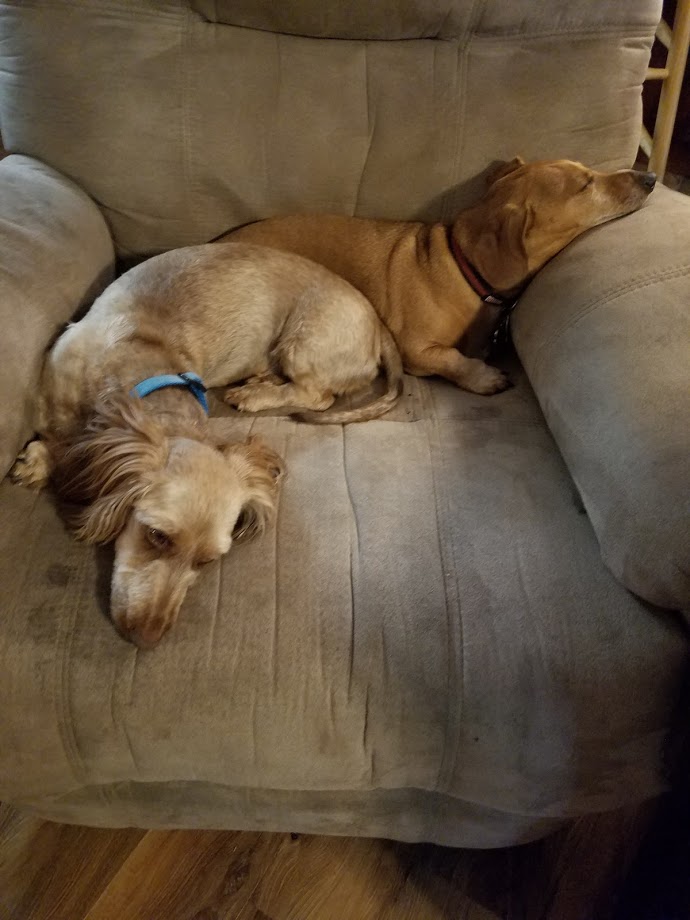
Losing a Toenail

(Kind of gross, so don’t read if you get easily grossed out by injuries.) My family has a fireplace in our house. Not an electric fire, not a fake fire, an actual fireplace with a brick chimney on our roof and everything. We use wood to build fires, so my dad and older brother chop wood in the summer to fill our woodshed for the winter. The children (once we were old enough, of course) were always in charge of getting wood from the woodshed to build fires that kept the house warm. It was much cheaper than using the house’s built-in heating system, and very effective when done correctly. We would go and put heavy pieces of wood in a wheelbarrow, move it over to the back door, and then pass them in fire-brigade style to the wood-box next to the fireplace. This was a system that usually worked very well. One day, however, it didn’t.

When my siblings and I were getting firewood on this one day, passing it through the doorway to someone inside by the wood-box, my sister handed me a really heavy piece of wood. I misjudged its weight, so it slipped through my fingers and landed straight on the big toe of my right foot. It hurt a little bit, so I handed the wood to my brother and walked inside, sitting on the couch and breathing for a few moments. My mom, who had seen what happened, panicked and took off my shoe to reveal that my sock was turning red. She gingerly took the sock off and saw that my big toenail was almost completely ripped away from my foot- the entire thing, not just the white edge. It was just hanging to my toe by a string of skin.

It was still bleeding heavily, so my mom put my foot in a bowl of warm water until the bleeding stopped and the pain ebbed a little bit. Once it stopped hurting too much, I was just happy to have gotten out of the rest of the work. My dad ended up carefully severing the dangling nail from my foot with a pair of pliers, and I just had to be extra careful with my toe for the next couple of weeks. It grew back in a couple of months, though the nail is a little malformed compared to the other ones, so no major harm was done. But it’s not the cool sort of injury you talk about, and it happened in a very minor way.

Breaking my Front Tooth

This one was very recent. Just last November, actually, here at college. One Friday night, my friend and boyfriend and I were going to watch a movie with the Harry Potter Club- I just needed to put my backpack away in dorm first, and my boyfriend was going to go call his parents for a bit. Since it was the winter, it was dark despite being just before 7pm. I put away my backpack, then came back to walk to the FoxHole (hangout spot where the movie was being shown) with my friend. My boyfriend was going to catch up with us later. A car was coming down the street, so we walked next to the parking lot for a little while instead of on the sidewalk. My friend suggested that we go to the other side of the road, so we crossed over. But when I lifted my foot to step onto the sidewalk, with all the force of power-walking behind me, my toes caught the edge, and I face-planted right onto the concrete.
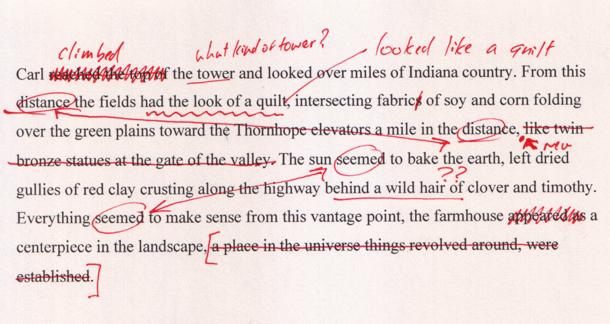
Falling is a weird feeling- you don’t quite realize that it’s happened until three seconds later, when you’re lifting your face off of the sidewalk and looking down in confusion at the small puddle of blood that’s growing. A tiny white chip of tooth lay next to the blood puddle, and reaching up with an adrenaline-trembling hand showed me that my lip had split open and my front right tooth had its bottom half snapped clean off. My friend had seen me fall- she managed to hold herself together in the face of a very understandable panic, looking for the campus security number to call on her phone. Someone walking on the street also saw the predicament, and got someone from the nearby Hadlock Student Center to come over with a first aid kit. More people came to assist- making sure my RA from just 50 feet away was contacted because she had to file an incident report, calling campus security to give me a ride to the emergency room, gawking at the flow of blood coming from my face. Honestly, it was embarrassing.

I felt no pain, due to being in shock, but I was frustrated at myself for getting such a stupid injury in such a stupid way. How hard can it be to step onto a sidewalk? Also, I hate dentists, and so the fact that now I would have to deal with one was anxiety-inducing. I would rather have broken my wrist, even though that definitely would have taken longer to heal. But in the end, all was well. Campus security drove me, and my friend, and my boyfriend (who had rushed up once he heard the news) to the emergency room (the other hospitals weren’t open, given that it was almost 8pm by this point). They ascertained that my lip didn’t need stitches, gave me an ice pack, and told me to go see a dentist to get my tooth fixed back on. Luckily, I’d saved the small chip of enamel, and they gave me a little container with cleaning fluid to put it in.

Telling my parents about it was… fun. I’d used up my yearly dose of college shenanigan stupidity without even trying. They contacted our dentist, however, who agreed to see me the very next day in order to fix my tooth. I had to eat around a swollen lip for the next two weeks, and only soft foods for roughly a week. Talking was difficult, singing even more so- unluckily, since I was in choir and since my job involves talking to people on the phone. My dentist informed me that I am no longer allowed to bite into apples or carrots with my front teeth. Everything has been fine, though. Almost three months later, my teeth are still okay, my lip has healed completely except for a tiny scar, and neither my friend nor my boyfriend abandoned me despite my stupid injury causing them to miss a fun night of watching a Harry Potter movie. As a matter of fact, they both stayed with me the rest of the evening. Not only did they come with me to the emergency room (out of no obligation, just because they were that nice), they came with me back to my dorm room and cheered me up. When I left to get a drink of water and came back, there was a mysterious dollar under my pillow from “the tooth fairy.” They still sat and ate with me even when I had to chew with my mouth open or find some way to get a spoon of oatmeal past my swollen lip. They are true friends, the real deal, and I’m lucky to have them in my life.

So yeah- those are some of the miniscule, but annoying injuries I’ve gotten over the past 18 or so years of living. I’m sure I’ll get injured in many more stupid ways before I die. While these were all somewhat crazy experiences, everything always turned out well, and sometimes it was even a good thing. I think especially in the case of me breaking my tooth, I was able to feel a lot closer to my friend and my boyfriend, and they really came through for me. I hope that when you guys inevitably suffer a similarly stupid injury, that you have good people to help you through it!

Featured

Sharing Writing

I have a love/hate relationship with showing my writing to other people. Sometimes I’ve written a blog post or poem or essay that I really want someone to read, and sometimes I never want another person’s eyes to see the disaster I just created. Occasionally, I’ll write only for myself, things too private to share with others. But since most of my writing is academic, I often end up showing it to others- professors for grading, friends for critiquing, and classmates for editing.

I’ve been taught the importance of peer editing ever since middle school. I remember when we would sit in groups of four, our desks pulled forward to form awkward circles, and passed our papers to the left. Or sometimes to the right, if we felt like shaking it up a bit. We had to edit with pen- pencil wasn’t allowed. We were supposed to look for grammar and formatting mistakes. In middle school papers, there were quite a lot of those. My teacher had a specific system with different shaped squiggles and slashes for specific mistakes: circling letters that should be capitalized, underlining misspelled words, etc. I won’t bore you with the details. But the point is, that’s where I first learned how helpful peer editing could be. Other people see mistakes in your writing that you would miss otherwise. We can be blind to our own typos and mess-ups.

High school taught me more nuanced forms of editing: looking for the flow of paragraphs, topic sentences, evidence for theses, correct citations, and other complicated things. While it was difficult at first, editing others’ papers helped me be able to edit my own far more objectively and concisely. And giving my paper to others allowed me to access feedback that I desperately needed, and tips I may not have thought about. A lot of the things I learned from peer editing groups in high school, I regularly use now in college.

However, that’s just the academic side of things. Showing my creative writing to people has always been far more difficult. For one thing, judgement seems a lot more harsh when it’s your heart and soul and ideas poured onto a piece of paper as opposed to just a response to a prompt. For another thing… I rarely have a substantial amount of creative writing to show anyone these days. With the large amounts of academic writing I’ve had to do for school, my time for writing creatively has dwindled to almost nothing. Whenever I do have a bit of time to write on my own, it’s usually plot outlining that no one sees, because it’s so rough and unedited, or a blog post that is immediately posted without any time for extensive review, because there are deadlines. I haven’t written a story and showed it to someone since November of 2018 when I tried and failed to complete NaNoWriMo (National Novel Writing Month). I really need to try and make more time to write creatively, and share it with others.

All things considered, I think that everyone should share their writing with someone. Who they share it with depends on the type of writing. If it’s a personal poem, share it with someone close to you. If it’s an essay, share it with a classmate. Feedback, constructive criticism and validation are all very important for any writer, and you can only do so much by yourself.

Featured

John Grisham’s Writing Process

John Grisham, author of famous legal thriller books like “The Firm” and “A Time to Kill” has a very interesting, specific writing routine. He’s been writing for a long time, and so he has a methodical process with details that have been well thought out.

One thing I thought was interesting was his schedule for writing- he says that he always tries to start a book on January 1st, with the goal of writing it in 6 months and usually being done by July. I don’t know if I could hold myself to that rigid of a schedule, and he says that he’s been doing it for at least 20 years. That’s a method that works for him, and I’m impressed that he’s been doing the same thing for so long- and with success.

Something about writing that we have common is that we don’t write the first scene until we know the last scene. I personally can’t begin writing a book without knowing what the ending of the book is going to be, what it’s leading up to and at least some idea of how it’s going to get there. Otherwise, how are you supposed to know how to start? He says he does that so that when he starts the book, he knows how it’s going to go, and once he does start writing, “there aren’t many down days.” I personally struggle with writer’s block and lack of time to write even when I know most of the plot points, the ending and the beginning, so that’s crazy to me as well.

All in all, his process is very well planned out, and it seems to work well for him. I don’t think I could be that crazy-scheduled; I need at least a little bit of spontaneity. But good for him that he’s been holding to a structured pattern for that long, and written so many successful books with it.

Featured

College Introvert Life Hacks

Some of you are extroverts. If you are, good for you! Have fun going to parties and living it up with your massive friend groups and explosive personalities. You all are awesome. This post probably isn’t super relevant to you, though.

Most of the rest of you, then, are introverts. If you’re stuck reading my blog, chances are you’re an introvert anyway. As much as we like people, we need time alone to recharge and chill out. Sometimes a night of staying in our dorm rooms and watching YouTube on our laptops sounds better than going to the Bruin Brawl or Trivia Night or whatever other exciting thing George Fox Activities has planned. Maybe I’m only speaking for myself, I don’t know. But if you think any of the above statements are somewhat relatable, read on for a couple of tips that I use when I just need to introvert for a little while.

Places to hang out:

Optimally, your dorm room. If you have a considerate roommate, or maybe one who is an introvert like yourself, then the dorm should be a great place to hide out and relax. No one to come in and judge you, no loud noises (unless you’re unlucky), and everything you need. Most college students have laptops- which are great to carry around with you, and you can use it on the desk or the floor or the bed or anywhere. There are good places to sit, things to do, and room to just be yourself. You might even have access to a hoard of snacks, if you’re like me and always want to snack on something. There’s always the danger of conversation with a roommate, but if both of you are chilling/working on homework, then a lot of the time the room can be quiet. And if it’s not, there are other options.

The library is also a good place to go, if not the number-one best. It can get a little loud in there, due to other peoples’ conversations, but if you sit by yourself usually no one will bother you. There are plenty of comfortable corners and little secluded places to be alone, even when surrounded by other people. The one at GFU even has a little coffee machine where you can get your caffeine fix if necessary. There are books to read (though a college library mostly has dry textbooks), people to interact with if necessary, and proximity to other places that you can get food if you want. Though the dorm is preferable, the library works well too.

Things to do:

What I usually do when I get some time to myself and need to “introvert” or de-stress is I sit and watch YouTube videos. These can be funny compilations, animations, animals, music, basically anything I feel like at the moment. If I’m not careful I can waste hours just watching “Try Not to Laugh” videos or, more shamefully, “America’s Got Talent” auditions.

Watching videos is fun and can make you laugh, but if you don’t want to feel like you’re letting time slip through your fingers and you still want to relax, there’s always reading a book. Underrated these days, I know, but it was my favorite thing to do as a kid and it still is now. It can be hard for me, as a college student, to get access to my favorite kind of book (a fantasy novel). But if I can get hold of one, it’s worth it. Reading both relaxes and engages your mind, and I can spend hours engrossed in a good story just as well as a lighthearted video. Do whatever your heart desires, though- watching movies, reading books, writing stories, just lying on the floor looking at the ceiling. Whatever you need to do to de-stress.

Things not to do:

Don’t force yourself to spend time with people if you need a little bit of time alone. It’s perfectly fine for you to relax a little bit by yourself. However, that doesn’t mean spending time with people is bad- just make sure to judge whether you need to be with friends or you need some space.

Don’t feel bad for being alone. Humans are social creatures, so even when introverts feel the need to be alone we can still end up lonely. Give yourself time to be apart, to be with yourself, and then seek out the people that you love to spend time with. A healthy balance of social interaction and self-time is key for being a fully functioning introvert in a mostly extroverted society.

In Conclusion:

It can be hard to be an introvert sometimes. Especially in college, when you’re surrounded by people. But it’s definitely doable, and worth the time. Even if you’re not in college, wherever you are in life, make sure to give yourself space if you need it.

Featured

My College People and their Top 10 Qualities

Roommate Qualities:

  1. Naming plants “Dolores” and “Ferb”
  2. Showering with said plants
  3. Owning a plush gnome
  4. Letting me use the fridge
  5. Giving me inspirational quotes mumbled by a Bob Ross figurine
  6. Showing me hilarious videos and Snapchat filters
  7. Buying me hot chocolate that one time
  8. Making Photoshop masterpieces
  9. Asking before letting her friends come over
  10. Vacuuming and cleaning up despite my messy side of the room

My roommate is awesome and I am blessed to know her

Friend Qualities:

  1. Sharing memes
  2. Showing me how to play badminton
  3. Getting obsessed with a show or video game and sharing everything about it
  4. Putting up with my puns
  5. Coming to my choir concerts
  6. Ranting about their classes and listening to me rant about my classes
  7. Giving me a dollar in lieu of the tooth fairy
  8. Bursting into song at random moments
  9. Talking until hours after the Bon closes
  10. Supporting me through the good times and the bad

My friends are awesome and I am blessed to know them

Boyfriend Qualities:

  1. Being my best friend first and foremost
  2. Framing his schedule around mine
  3. Telling me about his day
  4. Letting me know when something’s wrong
  5. Smiling
  6. Laughing
  7. Wreaking havoc on my self-doubt
  8. Buying me food when I work through the Bon’s dinner hours
  9. Learning about me and understanding my flaws
  10. Loving me, and letting me love him

My boyfriend is amazing and I am so blessed to know him

Self Qualities:

  1. Setting up a calendar with my schedule
  2. Eating healthier
  3. Working out regularly
  4. Getting to class on time
  5. Making time for my friends
  6. Doing things I enjoy
  7. Getting things done despite procrastination
  8. Acknowledging and moving past my flaws
  9. Trusting myself
  10. Being myself

As hard as it is sometimes, I realize that though I am not perfect, I am a good person and I am working on being better. I am blessed in so many ways and my life improves every day. I am human, but I am loved by others and I should try to love myself.

In the meantime, I am blessed to be here and be surrounded by so many good people.

I love you all.

Featured

The Process of Macaroni and Cheese

On any list about comfort foods, you can bet that macaroni and cheese will make the top ten. It’s warm, cheesy, gooey, filling, reminds people of their childhood- it ticks off any and all boxes for comfort food that could be ticked. But, such a simple recipe inevitably inspires many variations. From the boxed Kraft mac and cheese to fancy baked six-cheese versions, everyone has their own. This post is to argue about the process of my simple, three-ingredient mac and cheese with an uncommon ingredient, and why it is the best option.

This version is simple to make due to its small number of ingredients, and the short time it takes to cook. All you need is some pasta (any kind of macaroni will work), some cheese (I prefer to cut some cheddar cheese) and the unusual ingredient: a can of tomato sauce.

Now, hear me out. I can already hear my friends’ noises of disgust at the mention of tomato. A lot of people don’t like it. Mostly, the idea of tomato in macaroni and cheese sounds disgusting, or at least unusual. But trust me when I say it’s actually really good. It doesn’t taste out of place or clash with the cheesiness or anything. The flavors meld together very well and balance each other out.

But back to the process of making it. Again, it’s very simple.

  1. Cook the pasta. You should know how to do this; boil some water in a pot, put the noodles in, stir occasionally, take them out when they’re al dente (soft on the outside, but still slightly firm on the inside. Make sure you don’t let them get soggy, but don’t under-cook them either. If the noodles crunch, they’re not done).
  2. While the pasta is cooking, chop up some cheese. Cheddar is best, but other kinds can be fine too. There isn’t any specific ratio to use here, it’s simply according to taste and how cheesy you want your pasta to be.
  3. Drain the pasta and then put it immediately back in the warm pot (off the heat though so the noodles don’t burn). Then put the cheese you chopped into the pot, stir it in, and put the lid on the pot to trap the heat into it. The heat from the pasta will make the cheese melt, so leave it for five-ten minutes to allow that to happen. Feel free to add more cheese if it turns out you didn’t chop enough.
  4. Stir the pasta and the cheese together, then leave it to stick together for a couple of minutes while you grab the tomato sauce. If you add the sauce in too soon, then the cheese will pull away from the noodles which makes an unpleasant, grainy texture.
  5. Add the tomato sauce. Again, it depends on how much you’re making: when I make it for about seven people I generally use the whole can, but feel free to go heavy or light on the tomato. Either way, the whole thing should have a reddish-orangeish tint and look gooey and cheesy.
  6. Eat! It’s not allowed to get cold. Eat it while it’s still warm. Have one bowl, maybe two. You know you want it. Treat yourself. It’s good.

This is how to make the best macaroni and cheese you will ever eat. Trust me- it’s that good. I mean, all mac and cheese is good, but this stuff is top tier. A can of tomato sauce will take one of the best foods ever and make it heavenly. So enjoy!

Featured

Success in Writing

It’s hard for me to feel successful when I write.

When I was a little kid, I would always love the things I’d written. At every word of praise coaxed from my mother, I would glow; at every time I made my cousins laugh, I would shine with pride. I was convinced that I was the best writer ever, and that everything I wrote was great. I knew that once I grew up, I would write the best books ever written, and everyone would love them too.

Then, the doubt set in.

It started first with being compared to my sisters and cousins. I used to illustrate my books when I wrote them, because I enjoyed drawing almost as much as writing. But as my younger sister and my two cousins began to put more time into art, I started to feel inferior. They would nitpick things about my drawings, tell me what I’d done wrong, and as much as I would try to fix it, the criticism kept coming. Or worse, they’d smile vapidly and tell me it was great while sketching their own amazing piece of art and not giving mine a second glance. We had art contests sometimes, and I would always lose. My desire to draw tapered off until it was almost nonexistent, and I turned to just writing instead. But even then, the doubt of others being better had been put into my mind.

Then, I went to school. Middle school, where any sort of pride and joy I took in my writing was taken for bragging, and any sort of leadership or proactiveness I displayed was taken as bossiness. My peers were the instigators of this, not my teachers- their criticism and praise were always earned and appreciated. But children take to heart the words of their friends, and as my skills were casually maligned I stopped taking as much pride in my work. I stopped writing for fun as often as I used to, both for lack of time and lack of desire. I stopped showing my writing to people. I still loved to write, but I never felt like it was good enough. I would never finish projects I’d started. I doubted my own capabilities to even put the story that I wanted on paper. The few times I would show things to people, I would either get some praise (which I would smile at but then forget or assume was insincere), some criticism (which I would take to heart and add in, but wish for a few kind words as well), or worse, an incredulous look or laughter at some mistake I’d made. Most crushing of all was complete indifference, the most common response. I would anxiously send a draft of some creative writing piece to a friend, only to have the email sit unopened in their inbox for an entire semester.

Those were the things that slowly began my self doubt, which manifested itself not only in writing, but soon in physical appearance, intelligence, and any other category I’d once taken pride in. Art was long forgotten, and I’ve still never found the courage or desire to pick it back up again. Writing slowed, joy dimmed, and all thoughts of confidence were left behind in the dust. I would still write, but whenever I made a mistake or couldn’t progress further, the depression would set in and tell me I wasn’t good enough to continue. So I didn’t.

The doubt still lives in me, no matter how hard my boyfriend and friends and I try to work on it. College has been helpful so far: the independence and responsibility have assisted my taking charge of myself and my passions. As much as I am improving, though, it is slow work. On one day I may look in the mirror and feel proud of myself for all I’ve done. The next day I’ll glance in and feel a strong surge of shame in my reflection. Knowing I hadn’t done enough, I didn’t look good enough, I wasn’t smart enough. Days alternate, and I’m steadily getting better… but no one can recover instantly or completely from the dark pit of doubt.

My doubt is holding my mind hostage, and regaining control will take a long time.

With that being said, I have been able to find some small success in pieces that I write. A well-crafted sentence that brings a vivid image to mind will make me smile. Compliments on a concise article, an A on a paper I’d struggled over, excitement at the beginnings of a story… all of these bring some small vestige of success to me. These things make me feel happy. I know that I worked to achieve them. However, I have yet to be truly successful: to write an entire book and have it be loved.

I don’t need it to be popular. I don’t need it to be famous. I don’t need to be rich. If one person can honestly say that they love the book I’ve published, that it has inspired them, that they want to read more, I will feel like I have been successful. For me, part of the joy in creation is sharing my love of a story with others. Once I can do that, once I can put one of my novels to paper and have someone else enjoy it as much as I had, then I will finally know success.

Featured

Crowd Navigation

Some people are born for crowds. They have a natural sense of navigation, don’t mind the invasion of personal space, or just feel at home in a large group of other human beings. These people thrive in populated places such as New York City, Chicago, and your average college campus. Others, like me, feel like they’re stepping into six-lane traffic when entering a crowded area, looking both ways and checking blind spots and ultimately just going forwards, praying that no one will collide with them.

As a chronic introvert, I tend to avoid large public spaces, though venturing out in the real world can be fun on occasion. Ever since locker rooms in middle school I’ve always been afraid of knocking into people, or being knocked, because it’s happened frequently. Once, this burly absolute unit of a high school senior ploughed into me, knocking me to the cold tile floor, and ever since then I’ve resented high school boys always felt like I’m going to crash into some other person when we get too close. Getting over that fear when driving was fun, but while head-on collisions are less dangerous without giant metal vehicles, they’re far more common and still a threat. Especially when I hate being touched by strangers.

So, college can be a struggle. Sometimes the Quad is almost completely empty, and sometimes I feel like I’m going to take a nosedive and take out three other bustling students on the way. With sore legs from exercising in Hadlock, heavy backpack over my shoulders, and the frantic need to be on time to class, I feel every inch the frazzled college student portrayed in every realistic piece of media; tired, weighed down by homework, and really not ready to be in the same space as a couple thousand other people. But that’s kind of what college is, isn’t it?

To be fair, it’s much better than a public college would be, but some spaces- like the bridge over the canyon- are just not built for a ton of people to walk across at once, and there are a lot of factors that just make it worse. First of all, I am a fast walker. Especially when I have somewhere urgent to go. I tend to walk at least a little bit faster than most people, and passing them can be awkward… but not as awkward as slowing down to be stuck behind one person and dogging their footsteps. Second, lots of people tend to walk in groups, while I usually walk alone from class to class. Being surrounded by posses of girls talking loudly and clusters of guys laughing at some dumb joke not only makes it feel a little lonely to walk by myself, but also just makes it harder to get places. Have you ever tried to walk around a three-person group on a bridge that’s only about four people wide? Inevitably you collide with someone going the opposite direction, or someone has to slow down and stare awkwardly and let the other pass. Why do groups of people all walk next to each other in a line instead of a comfortable clump? It makes it harder for a lot of people around them. Not to mention the physical difficulties… some sidewalks are narrow, some are broken up in places and waiting to trip. There are some flights of stairs where annoyingly tall people go up two steps at a time and the slower people either meander uncaringly on their phones or hop quickly to keep up.

What’s worse than all these problems is… all of them combined. When I get out of my Theo 102 lecture class alongside at least half of the other freshmen, there is complete pandemonium. It’s like if every single commuter tried to merge onto the highway at the exact same time. Stay near the front of the group and you’re fine… but if you’re caught in the middle? Oh boy. Ohhhhh boy. Get ready for a real test of navigation skills and mental capacity, because you’re going to need every ounce of patience you can get.

It’s like traffic, if most people ignored the rules. There’s a slow lane and a passing lane, but some people take up both lanes and some are too slow to pass and some just straight up don’t let you get into the other lane. You get stuck in a strange pace, somewhere between a stride and a march, carefully timed not to flat-tire anyone’s shoes or disrupt the chaotic flow. More often than not, the road and sidewalk and bridge are one enormous puddle, with varying levels of depth, and so droplets of water get splashed onto tennis shoes, making socks damp and people annoyed. Any attempt to avoid a particularly deep puddle is met with the possibility of colliding into someone else, or slowing down the rhythm of walkers. If it’s raining, umbrellas may bump into each other, or people in wet sweatshirts might hurry even more than normal trying to get to whatever building they need to. Some people are talking to others, some are on their phones, some are just trying as hard as possible to avoid eye contact with strangers or, worse, acquaintances.

It’s bedlam, to be perfectly honest.

But I’d be lying if I said that even though it’s annoying to have to walk around all these people, I do kind of love the sense of community. Being part of a group is something I enjoy, introvert or not, and something about being close to so many people makes me really feel like I’m included in something. So while I hate collisions and physical contact with strangers, and being forced to slow down because of the loud girls in front of me with colorful buttons all over their jackets, I love walking on campus. It really does give you the feel of college.

Featured

Audience

I’ve never been a big fan of the idea of an “audience,” especially for writing. I loved to sing when I was a kid, but I would always get stage fright singing in front of someone else. Similarly, I didn’t like showing my writing to a lot of other people, because then they would inevitably judge it and make me feel self-conscious. I thought that I could just write for myself and never need to think about an audience. But as much as I love writing only for myself, I tend to do most of my writing for school- either papers for a teacher, or posts on this blog. Teachers are definitely an audience; which of us can truly say they’ve never specifically written some part of an assignment with exactly their teacher’s preferences in mind? However, I never thought much about audience until I began to write this blog.

When I saw on our class syllabus that we were required to write a blog, my first thought was of audience. I would be putting my writing out on the internet for everyone to see- not only my classmates and friends, but potentially complete strangers who would know nothing about me. Nothing but what I told them, and what they discerned through my writing. That was kind of frightening to me. How did I write to them? What kind of audience were they? I had literally no idea. Really, I still don’t. Mostly, right now, my audience is my classmates and my teacher. I have somewhat of an idea of how to write for them- write to the rubric for my teacher, write something interesting and funny for my classmates to comment on. That’s about as much consideration as I ever put into my audience, at least until we started talking about it in class.

We read two articles, “The Writer’s Audience is Always Fiction” and “Closing My Eyes As I Speak”. In the second one, the writer (Peter Elbow) discussed how audiences, whether they’re imagined or right in front of us, can often distract or confuse our writing. That has often been the case with me. I wrote a short story for my younger sisters once, and it was jumbled and confusing because I didn’t know how to write to them or what they’d like to read. Since audiences were hard for me to write to, I usually ignored them altogether and just wrote for myself. However, that won’t always be possible. if I continue with my dream of wanting to be an author, audience will become a much more important thing to me. They’re the people who will read my books, critique them, edit them, decide if they’re good enough to be sold, buy them, etc. I will need to deliberately write something they would like to read, otherwise I won’t be able to publish or profit off of my work.

As much as a writer can choose to write for themselves, an author doesn’t have that privilege. And if that’s what I’m planning to be, I’ll need to start putting much more thought into my audience than I do currently.

Featured

Japanese Convenience Stores

Since I went to a school named the Sheridan Japanese School, I aptly learned some of the Japanese language and culture. I had some teachers who were Japanese and came from Japan, some who were Japanese-American, some who had lived in Japan at some point or another, and alternatively some who had never been to the country and didn’t speak any of the language. However, the ones who taught me Japanese were usually from Japan.

In my sophomore year, I had the chance to be part of the school’s biannual Japan Trip, visiting the main island of Honshu for two weeks along with some other students and a few teachers. I had to raise about $2000 for my plane ticket and other expenses, but since most of the rest of it was covered by the school, it was absolutely worth it. We had a special elective class to prepare us for traveling, in which we learned how to talk with our host families, where we were going, and folded 100 paper cranes each. It was the most exciting semester of my life, looking forward to going out of the country and visiting someplace on the opposite side of the world. Finally, a few days after school got off, my mom drove me early in the morning to Portland Airport and I was on my first ever plane flight.

I’m not going to share all the details of my two-week trip, because that would be more like a short story than a blog post. I’ll probably tell a few more stories from my time there in some other posts. This time, however, I will share some of my favorite things about Japan, though there are a lot of them.

Firstly, it’s beautiful there. The cities are large and sky-scraping, and if you go a few blocks in any direction you can probably find a small forest shrine. You’re usually never more than a few miles away from a shrine or temple. It’s a wonderful mix of ancient/traditional architecture and modern buildings, and the variety of plants and animals are wonderful too. There’s about three types of places you can be in Japan- the city, the country, or completely secluded in nature. Only 1/3 of the land is habitable since the rest is so mountainous, and so there’s still a lot of wilderness in Japan. It’s majestic, and I love it as much as I love the Pacific Northwest.

The three places- city, country and mountain- all in once picture

Secondly, I love the culture. I didn’t get to see any festivals or anything while I was there, but everything about Japan was nice. The politeness of the people there, the vending machines on every corner, hard-to-navigate train stations, everything. Japan just had an atmosphere to it that I enjoyed a lot. I’d been learning some of the language and culture since 6th grade, and finally getting to go there and see it for myself was amazing. Sure, there were a few drawbacks, such as muggy weather (complete with mosquitoes) and sardine-packed Tokyo trains, but even those were worth it.

Finally, while the scenery and overall atmosphere of the place were wowing, one of the things I enjoyed the most about Japan was the food. Seriously, everything there is amazing. There are maybe one or two dishes I tried that I didn’t like, but they were outlandish foods like uni (the insides of a sea urchin) and natto (fermented soybeans). Everything else was absolutely delicious. Sukiyaki, katsudon, katsukare, yakitori, yakiniku, onigiri, udon, ramen, sashimi and sushi of all kinds, soup and salad and rice and even ice cream… the list goes on. Even the McDonald’s there tasted like four-star restaurant fare instead of a crappy fast food burger.

Katsukare, a pork cutlet with rice and curry sauce. Yum!

Japan absolutely ruined food for me, because nothing else can ever be that good. Not only was all of the food top tier, but a lot of it was cheap and easy to acquire as well. Something costing under 300-400 yen ($3-$4) was not an indicator of its quality- I regularly acquired inexpensive food that tasted better than any equivalent back home.

The most astonishing version of this I saw were the convenience stores, or konbini, every few blocks. The most common chain is one familiar to us, 7-Eleven. The first time I walked into a Japanese konbini, expecting the somewhat sketchy food and appearance I was used to in America, I was completely blown off my feet. Not only was the compact building clean and pristine, but the walls were lined with food that actually looked appetizing, as well as being about the same cost as the greasy fare in American convenience stores. Shelf after shelf of breads, noodle cups, sandwiches, onigiri, drinks, packed bento lunches, and more were efficiently placed in the small space. The purchasing counter had a heater full of freshly cooked tempura and meat. People quickly bought their selected items and then left. It was nice and quiet, small but not crowded. It was amazing.

A small sample of the sweet and savory breads they had available
The freshly fried tempura, corokke, chicken, and more
Bento lunches! Convenient and delicious

Two weeks in Japan was too short a time, and I missed it as soon as I left. I would love to visit again for a longer stay, maybe study abroad there? It was a great experience and though every part of the trip was amazing, I wish I could have brought an entire 7-Eleven konbini with me. If you ever travel to Japan, I highly recommend all of their food!

Featured

Blue January Sky

I love living in the Pacific Northwest for multiple reasons. No oppressive heat, very few poisonous animals, good mid-sized cities (except for Portland), and access to almost anything you could need within a few miles of civilization. The biggest reason, however, is the beauty. I love Oregon. There’s always green somewhere. In the summer, everything is lush and bright and green; in the fall, everything is crisp and colorful and sharp; in the winter, everything is chilly and stark and fashionably bare; in the spring, everything is blossoming and clean and new. Some say we only get two seasons (wet, and less wet) but I think we just get mild, pleasant versions of all four. And I absolutely love it.

With that being said, part of the reason I love my college, George Fox University, is the beautiful Oregon campus. Trees everywhere, soft green lawns, cozy college buildings, and the spiraling clocktower in the middle of the Quad. This may only be my second semester, but everything about GFU feels like home. I felt inspired to write this short blog post when I was walking back from class today, feeling and enjoying the chill around me, just kind of mindlessly strolling in the general direction of my dorm. Many people don’t see the beauty in an Oregon winter- we rarely get snow, so it’s usually just bare deciduous trees interspersed with conifers, squishy mud, and freezing air. But as I was walking today, I felt the impulse to look up. When I did, I saw the sky. It was beautiful- a light solid blue spotted with white puffs of cloud. It looked like a sky in the summer, but somehow it was even prettier because of the stark January-ness in the atmosphere. There was something mystical and wonderful about it… and I would have missed it if I didn’t look up.

Did you ever notice that? People don’t look up. They look down at their feet walking on the pavement when they want to avoid eye contact, as I do frequently. They look at their phones to check a text or the time. They will glance around them at the scenery sometimes, at the crowds of people, maybe talking to someone next to or in front of them. Occasionally, they may even quickly look behind. But they don’t look up. No one ever thinks to. It amazes me every time I point out to someone the luminous half moon in an evening sky, or a particular cloud that reminds me of something, or the way the sun comes through the leaves, or a bird flying overhead, how so many of these little things go unnoticed. How much beauty in the world do we miss by never looking up to appreciate the sky, to notice the tops of things that only the birds get to see? To wonder what it would be like to fly? It’s amazing how much of God’s creation goes unseen by distracted human eyes. He made these wonderful things for us, and the least we can do is appreciate them.

Featured

First Memories of Writing

As long as I could remember, as long as I could hold a crayon, I’ve been a writer. Any time I saw a piece of media I liked, my first impulse was to recreate it with my own meager talents. I was an artist first- scribbling down formless drawings of characters from my favorite book or TV show, then dictating to my mom the words she should write above them. Then once I learned to write, I would be the one jotting down stories above the doodles with my chicken scratch handwriting, complete with backwards Rs and mixing up “d” and “b”. I invented crazy tales for picture books and chapter books, all full of inside jokes only my cousins and I knew. Some of them were funny, but mostly they were unashamed copycats of characters that already existed and occasionally plot-lines that had already been run to the ground with overuse. Care Bears and Ponies often featured in these early pieces. Of course, as most first attempts at writing are, these stories were pretty bad. Objectively bad. My mom bound my many volumes in copy-store plastic rings anyway, and they’re still sitting under my bed at home, collecting dust. Sometimes, when I need a reminder of how far I’ve come, I’ll look at them and laugh and cringe.

I think my stories started to become actually imaginative somewhere around 4th or 5th grade. I started to make my own characters instead of using Princess Peach from Mario, My Little Ponies, Pokemon, and other mainstays of my childhood. As opposed to the toys I owned that already had shows or movies or video games, I would write about my regular stuffed animals and invent entire sagas based on their lives. Horses used to be my favorite animal, and I had a plethora of stuffed horses. However, I also had cats, dogs, bunnies, wolves, a giraffe, and various other members of the animal kingdom lying around my room. They became the focus of my creative imagination. Inventing a personality for each animal wasn’t enough; soon they had backstories, families, even allergies and birthdays. Those years were glorious. Though my dreams for the future still hadn’t solidified, and I oscillated between wanting to be a baker or a fairy princess, I couldn’t imagine a life without writing.

Once I finally went to an actual school, in 6th grade, my stuffed animal days were mostly over. I didn’t have the time to sit around and play once I’d done my work for the day, because there was always more homework to do. While I loved going to the Sheridan Japanese School, and though it was a creative charter instead of a public school, I struggled. I’d been homeschooled all my life and didn’t know how to deal with the constant pressure and orders from teachers. Socializing was another problem entirely, one I didn’t learn how to deal with for a couple of years. However, Language Arts class was my haven. Anytime we would receive a creative writing assignment, I would do it with enthusiasm and ease. I flourished.

I remember my excitement at learning how to type. Knowing that now I would be able to put more words on a page, faster than ever, excited me. Though I still struggled with deadlines and wasn’t used to school completely, I think that Language Arts and its writing homework fueled my determination to stay in school. Not only the creative fiction assignments, but even short middle school essays were enjoyable. I remember having particular fun writing an expository essay about how to cook macaroni and cheese. Adjectives were my best friends, and accurately conveying a thought from my brain to paper was the most satisfying thing I’d ever done. My brain wildly jumped from one writing prompt to the next. With every short story I wrote, I knew I could write at least twenty more pages on the same. I wrote about superheroes, magical worlds you could reach through a school locker, mysterious shoeboxes left under beds, and occasionally my stuffed animals would make a reappearance. I wrote essays on current events, wrote thoughtful responses to famous quotes, wrote ridiculous answers to traditional writing prompts such as “if you were stranded on a desert island, what three items would you bring with you?” Writing took over my thoughts and I loved every second of it.

When teachers began to ask the question “what do you want to be when you grow up,” I finally found the word that would let me write as much as possible. Author. Since 6th grade, my answer to that question has been, “I want to be an author” or “I want to be a writer.” My English teachers Arthurs-sensei and McLay-sensei, bless their hearts, encouraged my dream for all it was worth, and so that dream has begun to come full circle. I am an English major at George Fox, learning from authors and literary scholars and writers, and my dreams continue to follow the same general path. Though there are a few more realistic dreads of adult life and pit stops along the way, knowing that it won’t be easy to accomplish every dream I’ve ever wanted, that doesn’t stop me. I have wanted to write for most of my life, and that desire hasn’t left. Writing is my passion, and I can’t see that ever changing. I want to be an author.

Featured

Introduction

Hello everyone!

I’m Dorathy Dotson, a freshman college student currently going to George Fox University in Newberg, Oregon. I’m majoring in English with an emphasis in Creative Writing. This blog is an assignment for my Writing 200 class- some of my posts will be responses to prompts, and others will vary from my random musings on life to little creative writing bits. It depends on how I feel. However, it will always be something in the neighborhood of new and interesting.

I have always been interested in writing. Since I was a little kid, I would write everything from picture books to recipe books to straight up novels. Of course, since I was young, nothing was particularly good. But I’ve learned and grown, so while they’re still not very good, I’d like to think that my writing is improving. That’s part of what this blog is for.

Though this may be an assignment for a class, I’m planning to use this for all it is worth. I’ve always struggled with sharing my writing, and never found the idea of a blog appealing, but now that I’m being made to do it I’m going to go all in and try to learn as much as I can. Any of you who read this assortment of miscellaneous and confusing words will have to bear with me and learn with me as well. Who knows, maybe I’ll continue using it after the semester is over.

I’m working on my writing skills, so don’t expect too much, but if you want to see some interesting thoughts, hot takes, and the occasional bit of writing growth, then this is probably a good place!

Cheers,

Dorathy

Design a site like this with WordPress.com
Get started