Cover Letter RD

Purpose Statement: This blog post contains the rough draft of a cover letter for an internship, for my Writing 310 class.

This is a rough draft of a cover letter for an internship with the Simon & Schuster publishing company.

Dear Mr. Jonathan Karp:

I am writing to you today to apply for Simon & Schuster’s open position of the Summer 2021 Internship Program. I saw the advertisement on indeed.com, as I was looking for a good internship this summer. I am a sophomore currently enrolled in George Fox University, with a GPA of 3.8. I have a sincere love of books, which is required for this internship. Ever since I learned to read when I was 2 years old, books have been my passion. I enjoy reading, writing and editing, and I hope to be able to learn more about all three in this internship.

I am a fast and accurate writer, with typing speeds of around 93 WPM, and I often write for myself in my spare time. As part of my high school senior project, I began the process of writing a children’s book. Due to time constraints and extenuating circumstances, I never finished, but I was guided through the storyboarding process by a professional mentor. Heidi Schulz, a New York Times bestselling author, who has had three books published so far and many years of experience, taught me some of the processes of planning, storyboarding and writing a children’s book. This experience would be very helpful as a jumping-off point for the internship, having some background knowledge into what it is like to work as an author.

I have always had a passion for editing, including looking over my friends and siblings’ essays and correcting minor mistakes for them. Recently, I was employed as an “Advanced Writing Fellow,” a position with the LIBA 100 freshman writing class where I got to put my editing skills to good use. I assisted underclassmen in planning, writing and editing their papers, as well as helping the teachers lead writing workshops among the students. All editing interactions with students were in an online format, which has given me competency with using Zoom professionally. I have a large amount of relevant experience for this position, and I am a quick learner who is eager to continue learning about editing and publishing as a career. My skills in writing, editing, and communication make me a good fit for this internship, specifically in the editorial department.

Thank you for your time and for considering me for the position. I have included my resume and will follow up with more information whenever needed. I look forward to hearing from you.

Sincerely, 

Dorathy Dotson
Professional vs. Unprofessional Resume

Purpose Statement: This blog post for the Writing 310 class compares two different resume styles, and explains which one is better for me personally to use.

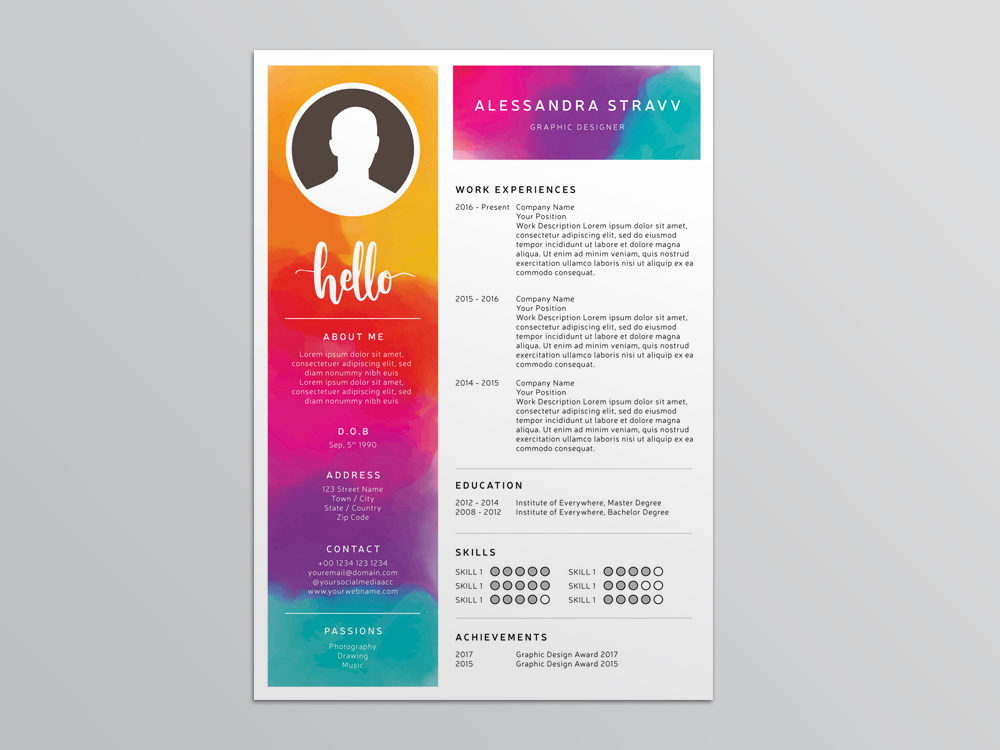
For this blog post, we were supposed to find two different resume styles and talk about which one is better for our professional goals. I want to be a writer and editor, so I need a resume that looks skilled and professional. The two styles I chose to compare were this style, and this style.

Style #1: A fairly bland looking resume that makes good use of white space, has user-oriented design in easy access to information, and looks well-made.

Style #2: A bright and colorful resume that catches the eye at first, but is clogged with needless information and trades professionality and functionality for initially pleasing aesthetic design.

If I were a graphic design major, an artist, or some other profession that may want rainbow colors popping off their resume, then obviously I would want to pick the second one. However, if I’m looking for a job as a professional writer or editor, then I would want the far more professional resume. It may seem kind of boring, but a good resume doesn’t need to be extremely interesting to look at. It needs to have the necessary information easily accessible. The rainbow resume looks good, but it’s confusing to find the information, and it trades space that could be used to convey why the applicant would be a good fit to catch the eye with bright colors instead. In the long run, it’s better for me to use the bland, professional resume.

To Use LinkedIn or Not to Use LinkedIn, That is the Question

Purpose Statement: A blog post for the Writing 310 class which answers the question, should I use LinkedIn?

Until going to college, I personally had never heard of LinkedIn. For my job searches, I would just google “Jobs in (City)” or use some job-finding site like Indeed. However, for this class we have been learning a little bit more about LinkedIn.

In this post I’m going to compare two different articles on whether or not to use LinkedIn. The first one is a professional source from Volume 118 of the Journal of Vocational Behavior, “Networking via LinkedIn: An examination of usage and career benefits.” This article is very steeped in academia, which is a polite way of saying it’s extremely dry and no good for casual reading, but I did get a few good quotes out of it in favor of LinkedIn. For example, “this study’s results demonstrate that networking online is associated with a wide variety of career benefits.” The article had an overall positive view of LinkedIn, saying that while it wouldn’t magically get you a job, it gave you a higher chance of getting professional connections.

The non-scholarly article I read was “LinkedIn is the worst of social media. Should I delete my account?” from The Guardian. The title is somewhat misleading, as it has positive things to say as well as negative about LinkedIn. It was full of complaints about the email spam and the people who use it for anything other than its intended purpose. Mostly, the author of the article said that it wasn’t good as a “social media” in the way that Facebook, Twitter and Tinder are social medias, but it sometimes worked well for its original intention, which was to find prospective jobs. “My investigative foray into LinkedIn suggested it offered more than merely a platform for congratulating friends on their ‘work anniversaries’ for a laugh. That’s not to say you should make it the sole site of your thought leadership, but the proliferation of recruiters on the platform means yes, it is advisable to have a profile with a recent picture, kept up-to-date and fleshed out with more than the bare minimum.”

So, comparing the two articles with each other, there is a fairly realistic view of LinkedIn. It isn’t guaranteed to get you a job, and the emails can be very spammy at times, but data and experience shows that it can be an effective tool to look for career options.

Personal Statement

Purpose Statement: This blog post is a personal statement about myself and my qualifications for the internship at Simon & Schuster.

Ever since I learned to read when I was 2 1/2 years old, books have been my passion. I spent my childhood reading and rereading my favorite books, and writing my own, and I’ve never stopped. I have had some professional experience with both editing and writing, and I hope to be able to learn more in this internship.

I am a fast and accurate writer, with typing speeds of around 93 WPM. I regularly achieve As in my English classes, and I often write for myself in my spare time. As part of my high school senior project, I began the process of writing a children’s book. Due to time constraints and extenuating circumstances, I never finished, but I was guided through the storyboarding process by a professional mentor. Heidi Schulz, a New York Times bestselling author, who has had three books published so far and many years of experience, taught me some of the processes of planning, storyboarding and writing a children’s book. This experience would be very helpful as a jumping-off point for the internship, having some background knowledge into what it is like to work as an author.

I have always had a passion for editing, including looking over my friends and siblings’ essays and correcting minor mistakes for them. Typos and grammatical errors pop out to me, whether I am reading a book or a text or an internet forum, and I am adept at fixing the issues that I find. My most recent employment was as an “Assistant Writing Fellow” for the LIBA 100 Freshman Writing class, where I got to put my editing skills to good use. I assisted underclassmen in planning, writing and editing their papers, as well as helping the teachers lead writing workshops among the students. This not only heightened my ability in editing, but helped me improve important soft skills such as communication and quick thinking. All editing interactions with students were in an online format, which has given me competency with using Zoom professionally. The formal editing experience I have received, along with my natural proficiency for it, would fit well with the editorial department internship. I would not only be able to use the skills that I already have, but work from there to gain more experience and knowledge into editing professionally.

I have a large amount of relevant experience for this position, and I am a quick learner who is eager to continue learning about editing and publishing as a career. My skills in writing, editing, and communication make me a good fit for this internship, specifically in the editorial department.

Job Skills Inventory

Purpose Statement: This blog post for my Writing 310 class lists and discusses some of the job skills that I have acquired.

I have had a variety of different job experiences that have given me a variety of different skills. Before I ever held an official job, I often helped my grandpa with yard work on his property in the country. He would pay me $10 an hour to rake hay or weed his garden, and doing that job for three or four hours a day every high school summer taught me how to maintain a high level of work activity. It was tempting to just sit there and listen to music and only work at half the pace instead of giving it my all, especially when I was tired, but if grandpa could tell that I hadn’t really been working then he wouldn’t give me the full amount of money. He believed strongly in work ethic, so I learned a little bit of that from him.

My first on-campus job was being a Phonathon Caller for the George Fox Advancement Offices, when I began going to college as a freshman. It was a job where students would call alumni, past faculty and student families, and ask for donations. It wasn’t an easy job, but I learned a lot. This job definitely helped me with my communication soft skills, such as meeting new people, taking independent action, and remembering information. I had to go off of a script, but also personalize each conversation to each stranger that I was talking to. In a three-hour shift, I would often hold ten to fifteen minute conversations with anywhere from ten to thirty people. While I’ll never work at a call center again if I can help it, those communication skills will definitely be useful in whatever job I have in the future.

The job I had last summer was a full-time job working at Walmart, eight hours a day, five days a week. That was another difficult job. Being on my feet for almost eight hours straight, constantly talking to customers, moving up and down, carrying heavy boxes, was a lot for me. However, I feel like it gave me a lot more valuable experience. I was able to provide customers with service, telling them which aisles to go to or helping them reach something on a top shelf. I endured long hours of work, and maintained records of item backstock and similar numbers. If I ever need to work in retail again, or even if I don’t, those skills will remain in my arsenal.

Probably the most helpful job I’ve had, in terms of skills I hope to use frequently in the future, was my job as an Assistant Writing Fellow last semester. I helped freshmen in the LIBA 100 Liberal Arts class with writing and editing their essays, and assisted course teachers with writing workshops. I determined and analyzed problems in the students’ writing and gave them advice on how to fix it. These writing and editing and communicating skills are the most similar to one of my prospective dream jobs, which is to work with an editing and publishing company. However, every single one of the jobs I’ve had has given me some skill that will be helpful in the future. A work ethic, thinking fast on the job, and persevering through long hours will be useful in any job.

Downtown Newberg

Purpose Statement: This blog post discusses observations of the downtown Newberg area that my professor and classmates can consider in the context of our class.

Observations:

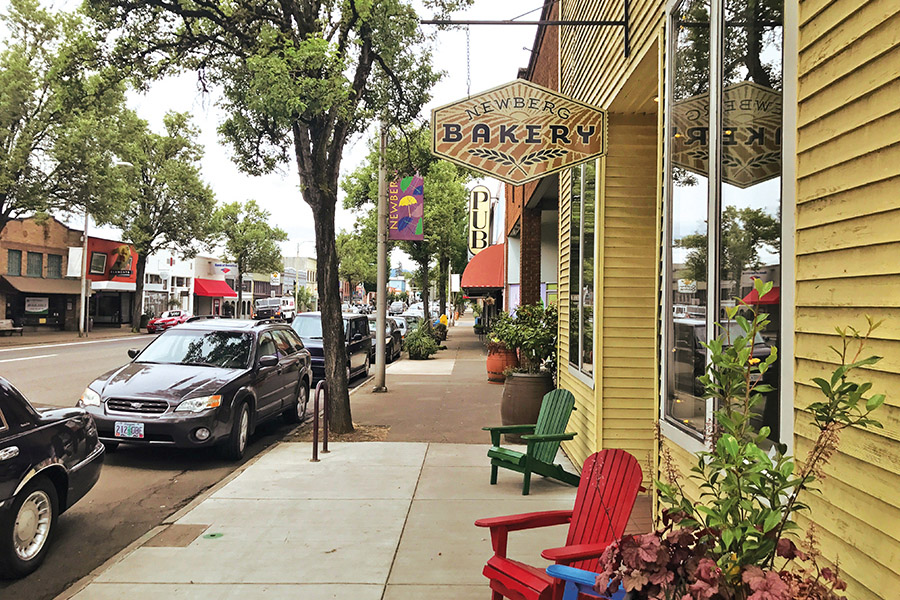
Newberg is a beautiful city, and it has a lot of wonderful places. The downtown area is one of my personal favorites, just to walk around and be in. As soon as you start walking down the street, you feel the area’s charm. The storefronts are well-kept, and many places have welcoming lights. The buildings are close together, so in the span of a thirty-second walk you pass a bakery, an antique store, a bank, and a coffee shop. No matter what you’re looking for, or even if you aren’t looking for anything in particular, you’re sure to find something you didn’t know you needed.

However, on the other hand, some of the buildings are old and worn down. The sides of brick may look ready to fall apart in a few more years, or paint may seem cracked and scratched. Most of these buildings are as old as Newberg, such as the City Hall, so a little bit of wear-and-tear seems inevitable. It’s really jarring, though, when you walk by a cute coffee shop and see a tall, off-peach building next to it that looks like it hasn’t been repainted in fifty years. Most of those are purely aesthetic problems, so the general vibe of the downtown area is still overall good.

I think that there are a few really good businesses in the downtown area that deserve more recognition. One of my personal favorites is the Gonzalez Taqueria y Panaderia, which sells tasty homemade Mexican food and pastries at really low prices. Off to the side a bit is also a business called Uflora, which sells house plants of many different shapes and sizes. I don’t personally have a plant, but I didn’t know until now that the shop existed– which is unfortunate, because it had a really charming feel and I’m sure anyone who wanted a succulent or an aloe vera plant would find whatever they needed there. I think a few businesses such as those can easily get lost in the cluster of welcoming storefronts, and so they could likely use a little bit of help promoting themselves.

Analyzing a Post from the Past

Facebook is a platform I seldom use, let alone post on. Usually I just use it to keep in touch with family members and see what they’re up to. Occasionally, if I have cool pictures to share or a development to announce, I’ll make a short post. The post I’m going to analyze, however, doesn’t really fit either of those categories: it’s a spur of the moment post I made more than half a year ago.

It’s warm and sunny outside. It smells like barbecue. My dogs are cute. No schoolwork till late August. Sometimes it’s nice to appreciate the little things, even in this chaos.” (May 2020)

Purpose:

The purpose of this post was really just for me to reflect, and to be optimistic. May of 2020 was a really hard month for me personally. COVID-19 had kicked me out of my dorm halfway through the semester, and though I’d just finished it, the pandemic showed no signs of slowing down. I used to think “oh, it’ll be over by April, maybe May,” but by that point I wasn’t sure. The rest of my family was worried as well. In this post, I focused on all the good things I could think of, trying to show myself and everyone in my “Friends” circle on Facebook (family members, friends, colleagues) that even in the face of the chaos happening, it was still okay to slow down and focus on the positive.

Audience:

As I mentioned before, the audience for this post was everyone I was friends with on Facebook. That circle is mostly my immediate and extended family, some of whom live far enough away that this is our only mode of communication. I also had a couple of friends, and some former classmates or high school teachers. Just a group of people I knew either deeply or on the surface level.

Stakeholders:

There aren’t really any stakeholders in this post– unless you count my dogs! It doesn’t really affect anyone. It’s just a short, positive message.

Context:

As I mentioned before, this was when America was really beginning to suffer from being in the throes of the pandemic. The “two-week” lockdown had been extended for an indefinite period. People were tired of being stuck at home. People were scared of the virus, and on behalf of their friends and family. I was hoping that if I tried to be optimistic in the face of the uncertainty, maybe I could help my friends and family be positive as well.

Bret Lott’s “Letters and Life”

In my Writing 200 class, we’ve been reading a series of essays from a book by Bret Lott, called “Letters and Life.” One of the essays I read was titled, “Why Have We Given Up the Ghost?” Its title doesn’t have very much to do with its contents, but instead Lott discusses his view on God and what writers, as Christians, should write about.

One of the things I thought was interesting about this essay was Lott’s view on the publishing industry. He names the publishing industry “New York” and calls it evil, saying that they are only focused on money. I’ve never tried to publish anything, but I can see where he’s coming from, with how difficult it can be to get things published if they won’t make good money. He says that instead of being focused on money, we should write focused on God. I also thought it was interesting that he put a lot of focus on not writing in our own wisdom, or assuming that we are wise, but letting God guide us in our writing.

Though the essay was interesting, it was also confusing at points, because he tended to ramble on with stories instead of spending time connecting them. He talked for a while about a miracle he’d experienced at a church camp, having enough gum and T-shirts for all the children when there were a lot more than he’d initially expected. He connected this with his earlier statement about believing in a “supernatural God,” but it didn’t seem to flow well with his rambling on about what writers should write about. Maybe I should just reread it and everything will make sense. Either way, I’m excited to read some of the other essays in the book, and I hope that they’ll connect a little better.

The Joy of Simple Tasks

I feel like people focus too much on achieving big, great things. Major accomplishments, sky-high goals, these are the things people like hearing about. However, I feel like we should place more emphasis on the happiness of completing simple tasks. Especially when you’re in college, learning how to be an adult, trying to focus on a hundred things at once, doing small things can be very good for you. For your consideration, I have compiled a list on some of the simple tasks I find satisfying, and that bring me happiness.

Cleaning my room– just living in a nice, organized space is satisfying. Having a little room of my own, where I know where everything is, feels nice.

Taking a shower– even though it feels like a lot of effort to get in and out, showers are important. Good for keeping you clean. They also feel really nice and warm (unless you take cold showers for some reason) and once I get out and get dressed, I feel 100% ready to do productive things.

Creating a schedule– especially when you’re in college. Not only is creating a schedule helpful to my daily life, but it makes me feel like a competent grown-up person taking care of myself. It’s so nice to look at the Google Calendar I’ve created and know what’s going on.

Driving somewhere– I personally just love the feeling of getting in the car. No matter where I’m driving, it’s nice to just sit alone in the driver’s seat, buckle in, turn the keys, blast some music, and drive off down the road. Especially if it’s in the summer and your windows are down. Especially if you drive on the highway. Especially if you’re going to have fun somewhere. But even in the middle of winter on a country road on the way to work, I enjoy driving.

Buying food– even just going to the store feels nice. But walking among shelves of food, picking out things that you want and need, then purchasing them, is wonderful. It’s just a little thing that feels so productive and adult-like, and satisfying. Bonus, I get to drive there!

Eating a meal I cooked– the act of cooking in itself is enjoyable. But then, sitting down to eat what you just spent time making is wonderful. Especially if the food tastes good. Even if it leaves something to be desired, you can look at the food in front of you and think “hey, I made this. I’m learning how to cook, I’m self sufficient.” If it tastes good, then even better.

Going to sleep– pretty self explanatory. Lying down in a comfortable bed at the end of a long day is satisfying and relaxing. Especially if it’s your bed, in your newly clean room, after a productive day of working and a delicious meal you made. Either way, getting in bed just makes the whole day worth it, so you can look forward to the next day.

These are some, but not all, of the small and simple tasks that I really enjoy doing. In times when everything is crazy, it’s important to find happiness in the little things.

The Book Industry’s Supposed Demise

The printing press was invented in 1440. For hundreds of years since, generations of avid readers have devoured books, keeping shelves in their home stacked with scores of leather bound tomes (and more recently, flimsy paperback novels), teaching their kids to read with primers and picture books. Recently, however, traditional book publication has begun to hit a decline. Publishing companies are losing money, self-publishing and e-books and audiobooks are becoming more popular, and the audience for books is rapidly dwindling. The book industry just isn’t what it used to be. Therefore, most statisticians predict its death, sometime within the next few decades.

As a lover of books, an aspiring author and an English major, this is vaguely worrying. A thousand fears could, and do, spring from these undeniable statistics. What if I can’t get a job? What if I write a book and no one publishes it? What if it is published, but no one buys it? What if my major is useless? What if since no one is writing, I can’t get an editing job? What if I can’t get physical copies of books anymore and I have to listen to audiobooks all the time?

However, all it takes is a few moment of thinking to put most of those fears to rest. Books will never truly die. Even if the publication industry shifts to e-books, which I don’t believe it ever will entirely unless we run out of trees, there will always still be an audience for reading. Even if the audience is smaller than in previous times, I can’t imagine the entire world leaving books behind in the dust as outdated or archaic. There will always be nerds like me who prefer the weight of a book in their hand, the smell of the paper, the sound of turning a page.

And, as long as people write, there will be editors. Whether those writers are journalists, or webpage authors, or book writers, they will need editing. Someone, somewhere, will be writing something, and it will need to be checked over for typos. Writers aren’t perfect, myself included, and people will always write. Therefore, there will always be a need for editors. I believe that is one of life’s true constants. Even if the book industry shifts somehow, I don’t believe it will ever truly die.

Design a site like this with WordPress.com
Get started